Cobra Effect · Everyday machines
How a touchscreen knows where you touched
How touchscreens sense your finger, and the decades of work behind them.
7 cards, read aloud in 2:42, with a test and sources.
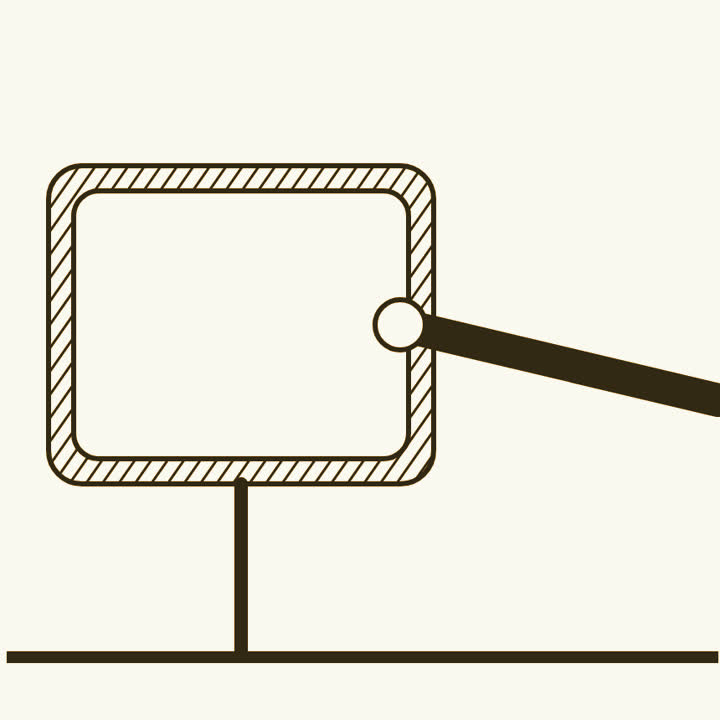
In 1965, the English engineer Eric Johnson described a display you could touch.
He worked at the Royal Radar Establishment in Malvern. His design sensed a finger touching wires laid across the front of the display. It is generally counted as the first touchscreen worked by a finger.
In the 1970s, engineers at CERN put touchscreens into daily use.
In 1972, Bent Stumpe, following an idea from Frank Beck, set out a touchscreen for controlling a new particle accelerator. It used fine patterns of copper on glass, too thin to see. By 1976, the accelerator’s control room was fitted with touchscreens.
Another kind of touchscreen responds to pressure.
In 1971, Samuel Hurst founded a company, Elographics, to make touch sensors. In its resistive screens, pressing brings two thin conductive layers together, and the point of contact is measured. They work with a gloved finger, or with any stylus.
Most phones use a different kind, called a capacitive touchscreen.
Under the glass is a grid of transparent conductive lines, in rows and columns. The phone keeps measuring the electrical charge at each crossing. A fingertip conducts, so it disturbs the electric field at the crossings beneath it. By finding which crossings changed, the phone locates one finger, or several at once.
That is why an ordinary glove or a plastic pen does nothing.
They do not conduct, so they barely change the field. Special gloves and styluses have conductive tips. Pressing harder makes no difference, because the glass is not sensing pressure.
Touching with several fingers at once was worked on for decades before smartphones.
Researchers built multi touch systems in the early 1980s, including at the University of Toronto and at Bell Labs. In 2007, the iPhone brought multi touch to millions of people. Apple did not invent the touchscreen, or multi touch.
So when a technology seems to appear overnight, ask how long it was being built.
The touchscreen took more than forty years to reach most pockets. Radar engineers, physicists and many researchers each added a piece. The finger on your phone rests on all of their work.
Sources
- CERN becomes one of the touch screen pioneers, CERN. The capacitive touchscreens built for CERN’s accelerator.
- The first capacitative touch screens at CERN, CERN Courier. How the copper patterns worked, by one of their makers.
- Multi touch systems that I have known and loved, Bill Buxton. A history of touch and multi touch systems from 1965 onward.
Nearby ideas
- The tiny switch that replaced the valve. How a slab of germanium at Bell Labs gave rise to every modern chip.
- How messages cross the internet in pieces. How messages cross networks as small pieces that each find their own way.
- The microwave oven and the melted snack bar. What the records show about how the microwave oven was invented, and how it heats.
- How GPS finds you by timing light. How GPS works out where you are by timing light, and allowing for relativity.
- Why a bright blue light took thirty years. How two teams made the bright blue LED that white LED lighting depends on.
- How a fridge moves heat out of a box. How a fridge carries heat out of a box, using a liquid that boils and condenses.
- How the barcode got from the beach to the checkout. How a pattern drawn in beach sand became the code on almost everything you buy.
- How a battery learned to carry lithium safely. How three scientists made a rechargeable battery that carries lithium safely.