Cobra Effect · Everyday machines
The microwave oven and the melted snack bar
What the records show about how the microwave oven was invented, and how it heats.
7 cards, read aloud in 2:38, with a test and sources.
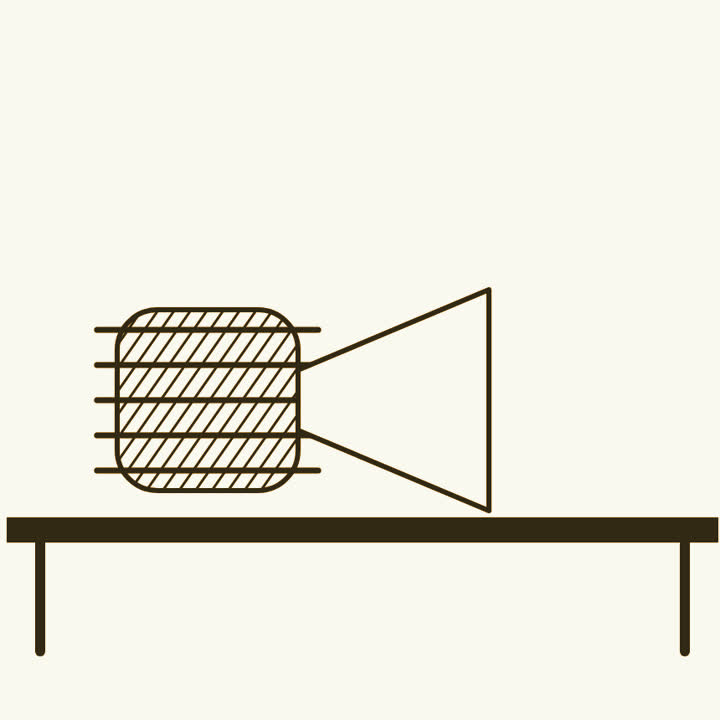
During the Second World War, Percy Spencer worked on radar at the company Raytheon.
He was a self taught engineer, and an expert on magnetrons, the tubes that produce microwaves for radar. Under his leadership, Raytheon greatly increased its production of magnetrons. Radar equipment gave off strong microwaves, and Spencer was not the first to notice their warmth.
A famous story says a chocolate bar melted in his pocket as he stood beside a magnetron.
The oldest account found is a magazine article from 1958, and it says a candy bar, not chocolate. Details such as chocolate and popcorn grew in later retellings. Whether it happened quite that way, nobody can now check.
What is documented is his patent.
In 1945, Spencer filed a patent for cooking food with microwaves. It describes cooking an egg and a potato, and says nothing about a snack bar. It reports that the potato cooked with a tiny fraction of the energy an electric oven needed.
A microwave oven heats food by making its molecules jostle.
A magnetron makes microwaves whose electric field flips direction billions of times a second. Water molecules, and some others in food, keep turning to line up with it. That jostling turns into heat.
Two popular explanations of this are wrong.
Microwave ovens are not tuned to a special resonance of water. Their frequency was chosen partly because it is a radio band set aside for such uses, and partly because it reaches into food instead of stopping at the surface. And they do not cook from the inside out. They heat an outer layer, and that heat spreads inward.
The first microwave ovens were enormous.
Raytheon’s first model, in 1947, was taller than a person and very heavy. A countertop model for homes arrived in 1967. Today, microwave ovens are in kitchens all over the world.
So when an invention comes with a perfect origin story, ask what the records show.
The melted snack may be true, embellished, or both. The patent, with its egg and its potato, is certain. What made Spencer an inventor was not noticing the warmth, but testing it.
Sources
- Method of treating foodstuffs, Percy Spencer, US patent, filed 1945. The patent itself, with its egg and potato.
- Microwave ovens, US Food and Drug Administration. How microwave ovens heat food, and why they do not cook from the inside out.
- Percy Spencer, Atomic Heritage Foundation. His wartime work on magnetrons.
Nearby ideas
- Light is a wave of electricity and magnetism. How equations predicted invisible waves, and sparks across a room proved them real.
- How a fridge moves heat out of a box. How a fridge carries heat out of a box, using a liquid that boils and condenses.
- How GPS finds you by timing light. How GPS works out where you are by timing light, and allowing for relativity.
- Why a bright blue light took thirty years. How two teams made the bright blue LED that white LED lighting depends on.
- How messages cross the internet in pieces. How messages cross networks as small pieces that each find their own way.
- How the barcode got from the beach to the checkout. How a pattern drawn in beach sand became the code on almost everything you buy.
- How a battery learned to carry lithium safely. How three scientists made a rechargeable battery that carries lithium safely.
- How a jet engine pushes a plane forward. How a jet engine drives a plane forward by throwing gas backward.