Cobra Effect · People and organisations
Pluralistic ignorance
Everyone can privately doubt a rule that nobody questions out loud.
6 cards, read aloud in 2:26, with a test and sources.
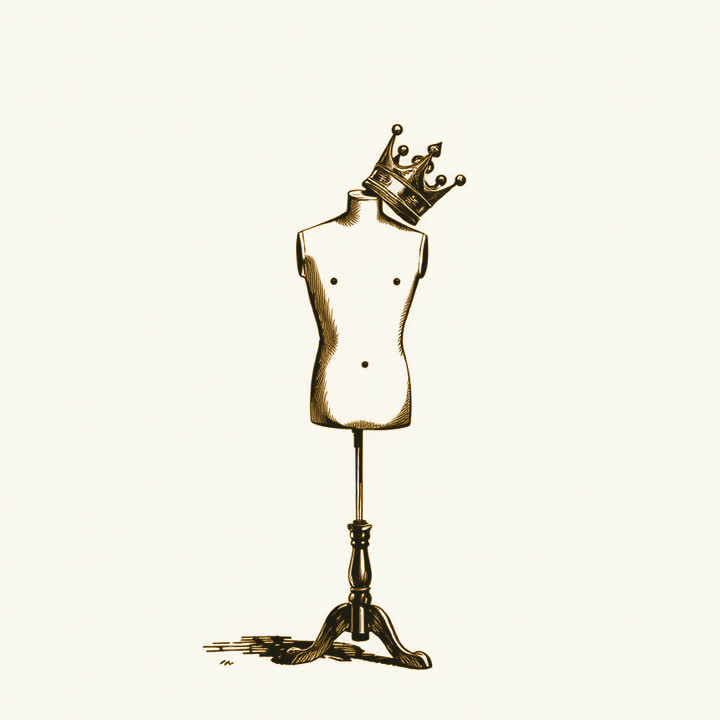
The emperor walks through the city naked, and everyone praises his new clothes.
Hans Christian Andersen, 1837. Two swindlers have sold the emperor a suit that is invisible to anyone unfit for their post. Nobody can see it. Everyone admires it. Each person thinks they are the only one who cannot see the cloth.
A child says the obvious. The spell breaks.
But he has nothing on, the child says. And the onlookers, who had known all along, suddenly know that everyone else knows. Andersen had understood something it took psychology a century to name.
Princeton, 1993. Students think everyone else loves drinking.
Deborah Prentice and Dale Miller asked students how comfortable they were with the campus drinking culture. Then they asked how comfortable the average student was. Nearly everyone said they were less comfortable than the average. Which is impossible. The average was made of them.
That is pluralistic ignorance.
Most people privately reject a norm, but believe most others accept it, so they go along with it in public. The going along is what everyone else sees. So the norm looks unanimous, and it is held up by nobody. Daniel Katz and Floyd Allport named it in 1931. It is the machinery inside the emperor’s parade.
It has consequences. The Princeton men drank more.
Over the term, the male students moved their private views toward what they believed the norm was. They didn’t change the norm. It changed them. The same trap sits under the classroom where nobody asks a question, and the meeting where nobody says the plan is bad. Everyone is waiting for the room, and the room is waiting for them.
How to be the child.
Ask the question privately, one person at a time. Do you actually think this is a good idea? Anonymous votes break it too, because the count shows the room what the room thinks. And when you doubt something everyone seems to support, say so once, out loud. You are probably not the only one who cannot see the cloth.
Sources
- Pluralistic ignorance, Wikipedia. The idea, its history from Katz and Allport, and the drinking study. Search Prentice and Miller 1993 Pluralistic ignorance and alcohol use on campus for the paper.
- The Emperor’s New Clothes, Hans Christian Andersen, 1837. The original, and it is very short. Read it again as an adult and notice that every single onlooker knows.
- Preference falsification, Wikipedia. Timur Kuran’s idea of what happens when whole societies say one thing in public and think another, and why regimes that look solid can fall in a week.
Nearby ideas
- The Abilene paradox. How a group can agree to something that nobody wants.
- Asch’s conformity experiments. Why people go along with a group they can see is wrong.
- Groupthink. How close, loyal teams talk themselves into bad decisions.
- Gall’s law. Complex systems that work grow out of simple ones that worked.
- Cunningham’s law. The fastest way to get the right answer is to post a wrong one.
- Pournelle’s iron law of bureaucracy. In any organisation, those who serve the organisation end up in charge.
- The bus factor. How many people could leave before the work stops.
- The iron law of oligarchy. Even democratic groups end up run by a permanent few.