Cobra Effect · People and organisations
Asch’s conformity experiments
Why people go along with a group they can see is wrong.
7 cards, read aloud in 3:02, with a test and sources.
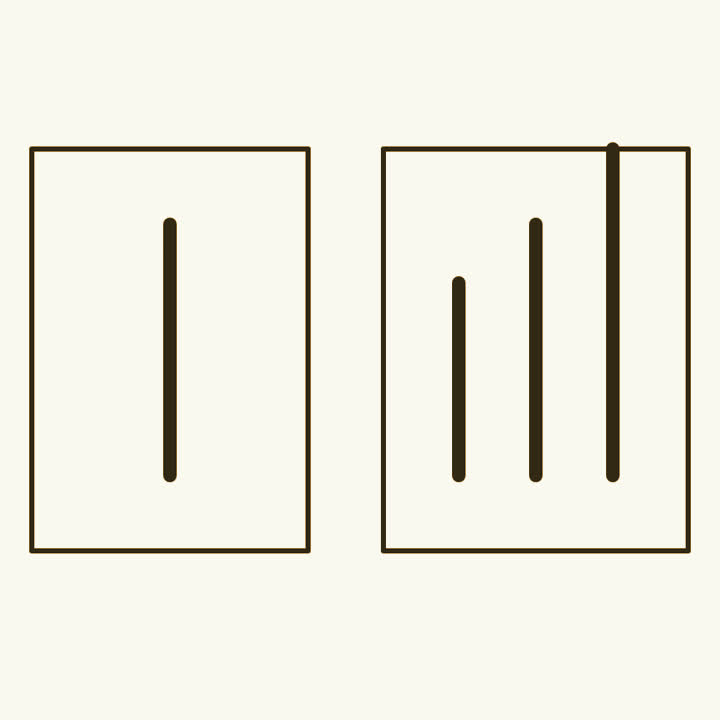
Swarthmore College, 1951. Eight students sit in a row and look at some lines.
On one card is a single line. On another, three lines of different lengths. The question is which of the three matches the first. It is not a hard question. The answer is plain to anyone with eyes. Each student says their answer out loud, in turn.
Seven of the eight are actors.
Solomon Asch has arranged it so the real subject answers last but one. For the first few rounds everyone agrees, and the answer is obvious. Then the seven actors all give the same wrong answer. Confidently. One after another. The real subject hears six people say something he can see is false, and then it is his turn.
About a third of the time, he agrees with them.
Across the trials where the actors lied, 37% of answers went with the group. Three quarters of the subjects went along at least once. A quarter never did, on any trial. Tested alone, people got the answer wrong less than 1% of the time. The lines had not changed. The room had.
Afterwards, Asch asked them why.
A few said they had actually seen what the group saw. Most said they knew the group was wrong, but did not want to seem odd, or assumed they had missed something. When subjects could write their answers privately instead of saying them aloud, the conformity mostly vanished. It was never about the lines. It was about being the only one.
One dissenter breaks it.
Asch added a single actor who told the truth. Conformity fell to about a quarter of what it had been. It fell even when the extra actor gave a different wrong answer. The subject did not need an ally who agreed with him. He needed proof that disagreeing with the room was allowed.
It is weaker now, and it is everywhere.
A 1996 review of 133 studies found the pull of the group had faded in America since the 1950s, and was stronger in cultures that prize the group over the person. It has not gone. It lives in every meeting where the first three people agree. The fourth person has the same eyes Asch’s students had.
So be the seventh actor, and hire one.
When you disagree with the room, say it early, before the third yes makes it expensive. When you run the room, collect views in writing before anyone speaks. And plant a dissenter. Someone whose job is to say the other answer, right or wrong. One voice is enough. Asch measured it.
Sources
- Opinions and Social Pressure, Solomon Asch, Scientific American, 1955. Asch’s own short account of the experiments, written for a general reader. Search the title with the year for a copy. This page is about Asch himself.
- Influence: The Psychology of Persuasion, Robert Cialdini, 1984. The chapter on social proof is about what Asch measured, and what salespeople, cults and canned laughter do with it.
- Asch conformity experiments, Wikipedia. The setup, the numbers, the variations with dissenters and private answers, and the 1996 review of how the findings have changed across decades and cultures.
Nearby ideas
- Groupthink. How close, loyal teams talk themselves into bad decisions.
- The Abilene paradox. How a group can agree to something that nobody wants.
- Psychological safety. Teams only learn from the mistakes they feel safe to admit.
- Little’s law. How long things wait depends on how many are already waiting.
- The Ringelmann effect. The bigger the group, the less effort each person puts in.
- Milgram’s obedience experiments. Ordinary people follow harmful orders when the setting pushes them.
- Pluralistic ignorance. Everyone can privately doubt a rule that nobody questions out loud.
- Gall’s law. Complex systems that work grow out of simple ones that worked.