Cobra Effect · People and organisations
Sayre’s law
The smaller the stakes, the fiercer the argument.
6 cards, read aloud in 1:57, with a test and sources.
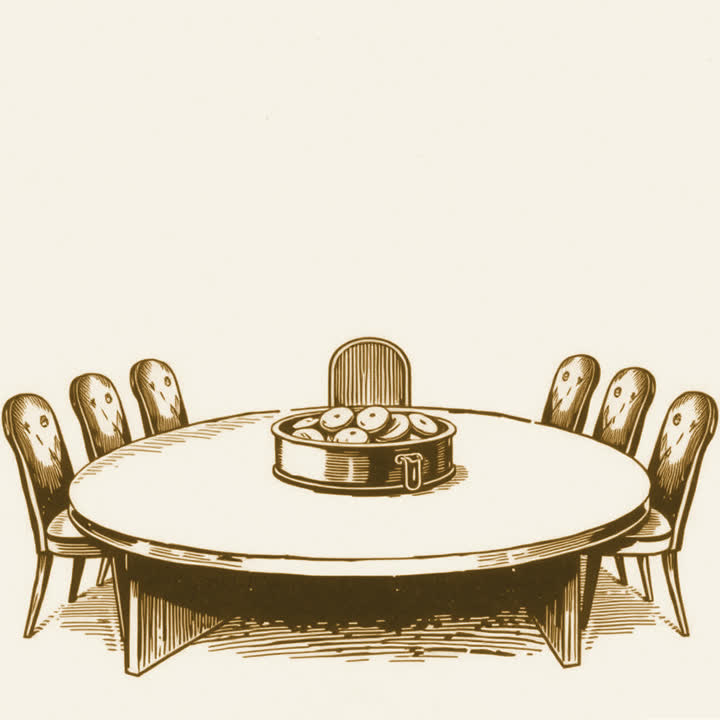
The committee spends 40 minutes on the biscuits and 4 on the budget.
The budget runs to millions. The biscuit tin costs almost nothing. Everyone has a view about the tin. Nobody wants to reopen the budget.
Wallace Sayre taught politics at Columbia, and he noticed the pattern.
In any dispute, the version usually quoted runs, the intensity of feeling is inversely proportional to the value of the issues at stake. The smaller the stakes, the fiercer the fight.
His favourite example was the place he worked.
Academic politics are so bitter, the corollary goes, because the stakes are so low. The wording shifts depending on who is quoting it, and similar jokes get pinned on other people. The observation survives the muddle.
Why the small thing gets all the heat.
Everyone understands a biscuit tin. Almost nobody understands the pension line. You can hold a strong opinion about the tin without reading anything first. And if you lose, you lose nothing, so there is no reason to hold back.
The cost is not the wasted hour.
It is the item nobody argued about. The expensive decision slides through on a nod, because it is hard and dull and nobody feels expert. The loud item is safe. The quiet one is what will hurt you.
What to do at the next meeting that goes this way.
Put the costly items first, while there is still patience in the room. When the temperature rises, ask out loud what actually turns on this decision. If the answer is almost nothing, take a vote and move on. Save the heat for something that deserves it.
Sources
- Sayre’s law, Wikipedia. The wording most often quoted, the corollary about academic politics, and the tangle of who said what and when.
- Parkinson’s Law and Other Studies in Administration, C. Northcote Parkinson, 1957. The collection containing the committee chapter, in which a board approves a reactor in minutes and argues for an hour about a bicycle shed.
- Law of triviality, Wikipedia. The same pattern from the other end, written up as the bicycle shed problem and later borrowed by software teams.
Nearby ideas
- Parkinson’s law. Work expands to fill the time you give it.
- The Abilene paradox. How a group can agree to something that nobody wants.
- The Eisenhower matrix. Urgent things crowd out important ones unless you protect them.
- Amara’s law. We overrate new technology in the short run and underrate it in the long.
- Tuckman’s stages. Why new teams have to fight before they can work well.
- The Robbers Cave experiment. Rival groups make peace when they need each other, not when they mix.
- The ninety-ninety rule. The last tenth of a project takes as long as the first nine.
- Span of control. Why a manager can only really lead a handful of people.