Cobra Effect · People and organisations
Parkinson’s law
Work expands to fill the time you give it.
5 cards, read aloud in 1:29, with a test and sources.
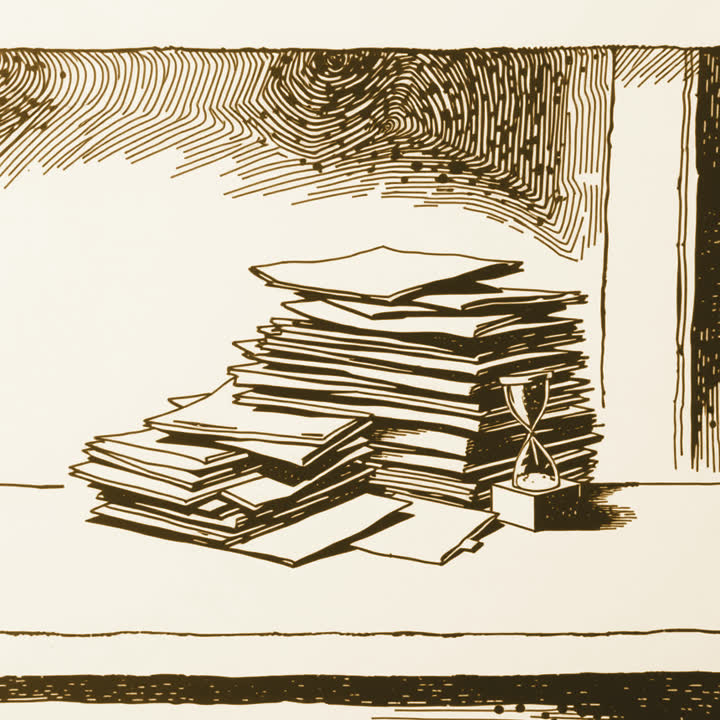
Work expands to fill the time available for its completion.
Cyril Northcote Parkinson wrote that in The Economist in 1955. He meant it as a joke about the British civil service. It turned out to be a law.
The elderly aunt and the postcard.
Parkinson’s example is a woman with nothing to do who spends a whole day sending a postcard. An hour to find the card. Another to find her glasses. A busy person would do it in three minutes.
The task doesn’t have a size. The deadline gives it one.
Give a report two weeks and it becomes a two week report. Give it two days and most of the same content arrives, slightly plainer. The extra twelve days went on polish, worry and meetings about the report.
He also noticed the bike shed.
His other law is about triviality. A committee approves a nuclear reactor in minutes, because nobody understands it. Then argues for an hour about the colour of the bike shed, because everyone does.
What to do with it.
Set the deadline shorter than feels comfortable. Decide what done looks like before you start, so polish has a stopping point. And when a meeting drifts to the bike shed, name it.
Sources
- Parkinson’s Law, C. Northcote Parkinson, 1955. The original essay ran in The Economist on 19 November 1955 and is still on their site. Search the title with the date. The article quotes it and traces the book that followed.
- Parkinson’s Law: The Pursuit of Progress, C. Northcote Parkinson, 1957. The essay expanded into a small, very funny book about committees, the growth of staff and the elderly aunt and her postcard. Still in print.
- Law of triviality, Wikipedia. The bike shed, with the reactor and the coffee for the committee. Where the phrase bikeshedding comes from and why software teams adopted it.
Nearby ideas
- Brooks’s law. Adding people to a late project makes it later.
- The Peter principle. Why people get promoted until they reach a job they cannot do.
- The sunk cost fallacy. Money already spent is gone, so it should not steer the next choice.
- Conway’s law. Systems end up shaped like the teams that build them.
- The Hawthorne effect. Being watched changes what people do, and muddies what you measure.
- Dunbar’s number. Why groups stop working the old way once they pass about 150.
- The bystander effect. The more people who see a problem, the less each one acts.
- The fundamental attribution error. We blame people’s character and overlook their situation.