Cobra Effect · People and organisations
The Robbers Cave experiment
Rival groups make peace when they need each other, not when they mix.
7 cards, read aloud in 2:39, with a test and sources.
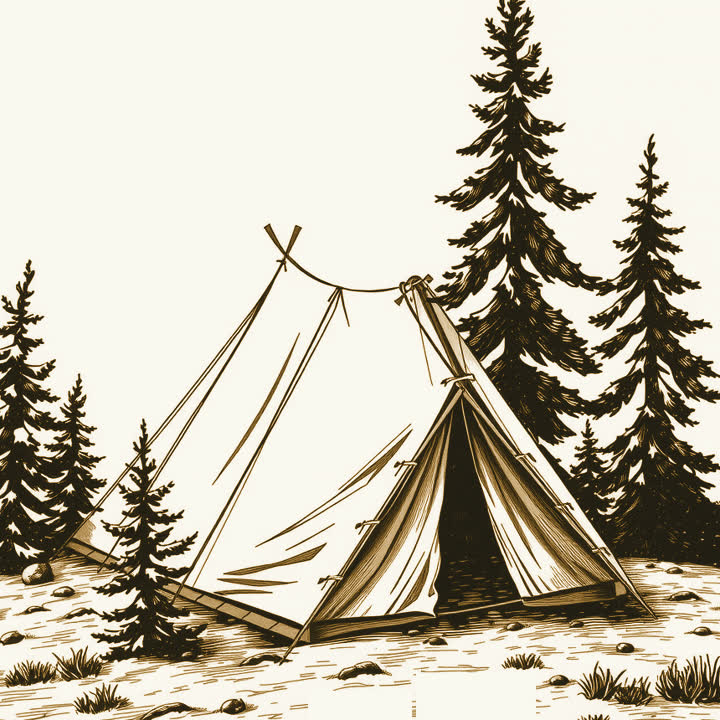
Oklahoma, 1954. Two buses bring 22 boys to a summer camp.
They are 11 years old, from similar homes, and none of them has met before. The buses arrive separately, and for the first week each group believes it has the park to itself. The camp staff are psychologists. The boys are not told that.
Within days each group has a name, a flag and a set of rules.
They call themselves the Rattlers and the Eagles. Nobody told them to. A week alone in the woods was enough. Then the staff let each group discover that the other one exists.
A tournament is arranged, and it goes bad fast.
Baseball, tug of war, a trophy and pocket knives for the winners. Within days there is name calling, a burned flag, raided cabins and stolen kit. These are ordinary boys who had never met each other a fortnight earlier.
Muzafer Sherif tries the obvious cure first.
He puts them together. Meals, films, fireworks. It makes things worse. The dining hall turns into a food fight. Simply being in the same room fixes nothing at all.
What worked was a problem neither group could solve alone.
The camp water supply failed, and both groups had to walk the pipeline and clear the tank. A truck bringing food would not start, and they hauled it with the tug of war rope. Sherif called these superordinate goals. By the end the boys asked to ride home on the same bus.
The story is famous. It is also messier than the retelling.
Sherif ran an earlier version in 1953 at Middle Grove in New York, and it failed. Those boys refused to turn on each other. It went unpublished for decades. The psychologist Gina Perry documented it in 2018 in The Lost Boys.
The staff were not neutral, and the lesson still holds.
The researchers were the camp counsellors. They set the contests and at times stirred the trouble. The boys and their parents were not told what was being studied. So treat it as a demonstration, not a proof. The practical part has held up well. If two teams are at war, do not sit them in a room. Give them a job that needs both of them.
Sources
- Robbers Cave experiment, Wikipedia. The 1954 study in detail, the three stages, the superordinate goals that repaired it, and the criticisms of the method and the ethics.
- The Lost Boys, Gina Perry, 2018. An archive history of Sherif’s camps, including the earlier run at Middle Grove in 1953 where the boys refused to fight and the study was quietly shelved.
- Superordinate goals, Wikipedia. The repair mechanism on its own: goals that matter to both groups and that neither can reach alone, and what has been found about when they work.
Nearby ideas
- Groupthink. How close, loyal teams talk themselves into bad decisions.
- Asch’s conformity experiments. Why people go along with a group they can see is wrong.
- The fundamental attribution error. We blame people’s character and overlook their situation.
- The ninety-ninety rule. The last tenth of a project takes as long as the first nine.
- Span of control. Why a manager can only really lead a handful of people.
- Broken windows theory. Visible neglect invites more of it, though the crime claims are contested.
- Parkinson’s law. Work expands to fill the time you give it.
- The Peter principle. Why people get promoted until they reach a job they cannot do.