Cobra Effect · Decisions and strategy
Ulysses contracts
Bind your future self before the temptation arrives.
7 cards, read aloud in 2:17, with a test and sources.
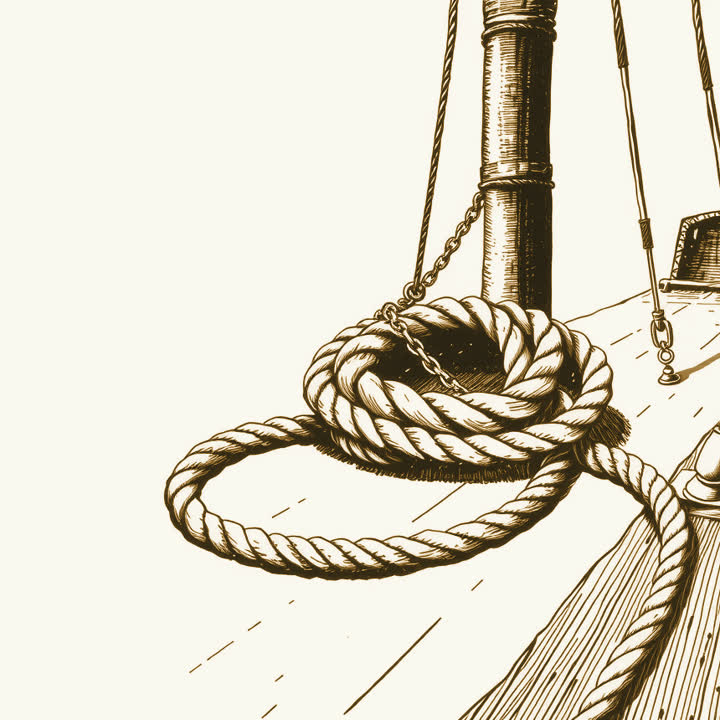
The sailors put wax in their ears. The captain wants to listen.
Odysseus has been warned about the sirens, whose singing pulls ships onto the rocks. He wants to hear it and live. So he gives an order that takes the choice away from his future self.
Tie me to the mast. If I beg, tighten the ropes.
The crew hear nothing and row on. Odysseus hears everything, strains against the ropes and orders them to turn the ship. They ignore him, because he told them to. The ship sails past.
The trick is to decide twice, once while you are still sensible.
A promise you make to yourself is open to renegotiation at the worst possible moment. A promise with a lock on it is not. Bind the version of you who will want to change the plan.
Which is why the phone goes in the other room.
A savings account you cannot touch until a date. A block on the sites that eat your evening. Money left with a friend, to be given away if you smoke again. None of these argue with you. That is the entire point.
Economists tested this in the Philippines in 2006.
Bank clients were offered an account they could not withdraw from until a goal or a date they chose themselves. Not many took it. Those who did saved substantially more than those who did not. The lock did the work that willpower could not.
The same idea turns up in serious places.
Some people with an illness that comes and goes write instructions for their own care while they are well. The document speaks for them at the moment they cannot. It is the mast again, in a hospital.
Build the lock on a good day.
Pick the moment you always lose, and set the trap well before it arrives. Make undoing it slow, public or expensive, and leave yourself a way out for real emergencies. You are not weak. You are just not going to be there when the singing starts.
Sources
- Ulysses pact, Wikipedia. The name, the story it comes from, and the modern uses, from savings accounts to instructions written in advance for medical care.
- The Odyssey, Homer. The original. Book twelve has the sirens, the wax and the ropes, and it is shorter and stranger than you remember.
- Commitment device, Wikipedia. How binding arrangements are used and where they backfire. For the savings trial, search for Tying Odysseus to the Mast, by Ashraf, Karlan and Yin, 2006.
Nearby ideas
- The pre-mortem. Imagine the project has already failed, then ask why, before it starts.
- Schelling points. Without talking, people meet at whatever stands out.
- Two-way doors. Decide reversible things fast, and save care for what you cannot undo.
- Zero sum thinking. Most deals are not fixed pies, and treating them as one wastes value.
- Tit for tat. Cooperate first, answer a betrayal once, then forgive.
- BATNA. Your power in a negotiation is what you will do if you walk away.
- Explore and exploit. When to try something new, and when to stick with what works.
- First principles. Rebuild a problem from what must be true, not from what everyone does.