Cobra Effect · Decisions and strategy
First principles
Rebuild a problem from what must be true, not from what everyone does.
6 cards, read aloud in 2:25, with a test and sources.
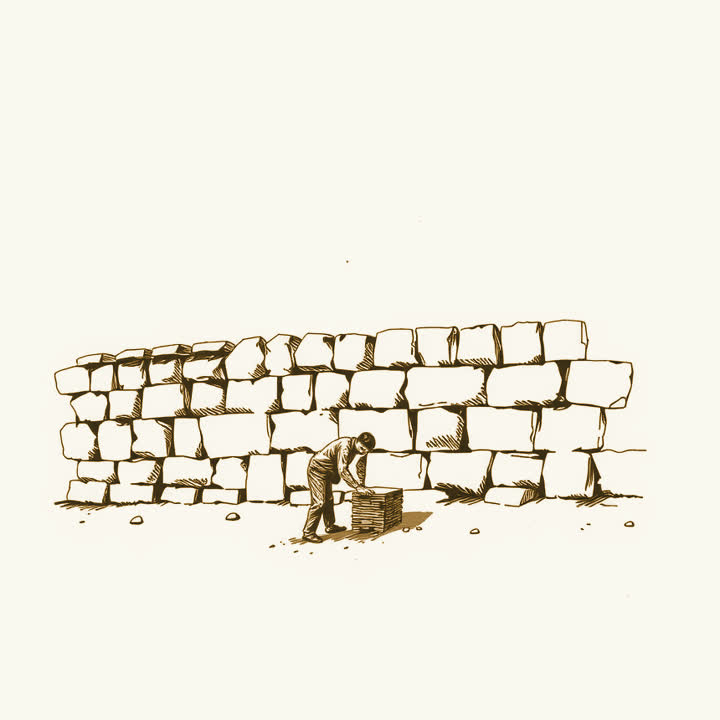
Every answer rests on another answer. Aristotle wanted to know where that stops.
Ask why the wall is built that way and you get a reason. Ask why that reason holds and you get another one. Aristotle noticed the chain has to stop somewhere, at something you cannot get behind. He called those stopping points first principles.
In the Metaphysics he puts it plainly.
A first principle is the first basis from which a thing is known. Not the first thing you happen to believe. The first thing that has to be true. Everything above it is built, and anything built can be argued with.
The method is to reason up, not across.
Reasoning across means starting from what everyone else does and changing it a little. Reasoning up means listing what must be true, then building an answer out of those pieces. Across gives you the herd’s answer with a small discount. Up can give you an answer nobody has.
Around 2012 a carmaker did the arithmetic out loud.
Everyone knew a battery pack cost about $600 a kilowatt hour and always would. Elon Musk asked what a pack is made of. Carbon, nickel, aluminium, steel, some polymers. Bought as raw metals, he said, those came to about $80 a kilowatt hour. The gap was not physics. It was how everybody had always bought them.
Raw metal is not a battery, and the sums took years to cash.
The arithmetic did not build anything. Factories did, slowly and expensively. What it bought was a reason to keep going when the price looked fixed forever. That is the real use of it. It tells you which walls are brick and which are habit.
So take one fixed cost and ask what it is actually made of.
Write down the thing you believe is fixed. The rent, the six week lead time, the price per unit. Under it write only what must be true. Materials, hours, distance, law. Whatever is left over is convention, and convention is negotiable. Start there.
Sources
- Metaphysics, Aristotle. Where the first basis from which a thing is known gets its definition. Dense going in the original. This page lays out the argument and which books it sits in.
- Discourse on the Method, Rene Descartes, 1637. The other great attempt to knock everything down and rebuild from what cannot be doubted. Short, readable and free online.
- First principle, Wikipedia. The idea across philosophy, physics and engineering, including where the modern business version shades into marketing.
Nearby ideas
- Inversion. To find the path to success, first ask what would guarantee failure.
- The Feynman technique. If you cannot explain it simply, you have found a gap.
- The map is not the territory. Every model leaves something out, and that is where it fails.
- Opportunity cost. The real price of anything is the best thing you gave up for it.
- Chesterton’s fence. Before removing a rule, find out why it was put there.
- The sunk cost fallacy. Money already spent is gone, so it should not steer the next choice.
- The broken window fallacy. Destruction makes visible work and hides the cost of what was lost.
- The pre-mortem. Imagine the project has already failed, then ask why, before it starts.