Cobra Effect · Decisions and strategy
Two-way doors
Decide reversible things fast, and save care for what you cannot undo.
6 cards, read aloud in 2:36, with a test and sources.
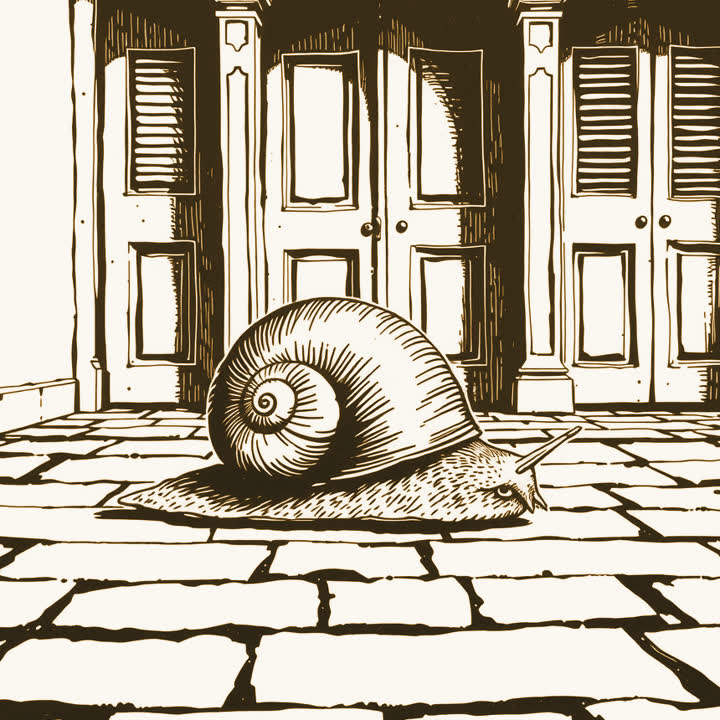
A company grows, and somehow every decision starts taking a month.
Choosing a font needs a meeting. Trying a new supplier needs a committee. Nobody decided to be slow. The slowness arrived one careful process at a time.
Jeff Bezos wrote about it in his 2015 letter to Amazon’s shareholders.
Some decisions, he said, are one way doors. Walk through, and you cannot come back. Those deserve to be made slowly, carefully, with deliberation and consultation. But most decisions are two way doors. If you don’t like what you find on the other side, you open the door and walk back.
The mistake is using the one way process on two way doors.
As organisations grow, Bezos wrote, they tend to run every decision through the heavyweight process built for the irreversible ones. The result is slowness, timidity, too little experiment, and less invention. The two way door is not a small decision. It is a cheap one to undo. That is the only thing that matters about it.
So sort the door first. Then pick the speed.
A two way door: try the supplier for a month. Change the meeting time. Ship the feature behind a switch. Run the ad for a week. A one way door: sell the building. Fire the person. Sign the ten year lease. Tell the customer the price. Delete the data. Two way doors should be walked through fast, by one person or a few, and revisited if wrong. One way doors get the committee.
Some doors lie about which kind they are.
A public announcement looks like a memo and is a one way door. A hire looks reversible and mostly isn’t. A big rewrite feels like a two way door until half the team has left. The test is not how big it feels. It is what it would cost, in time and money, to be back where you started.
The question, before any decision.
Can we walk back through this, and what would it cost? If the answer is yes and not much, decide today, with the information you have, and go. Save the slow, careful, everyone in the room process for the doors that only open one way. Most of them don’t.
Sources
- 2015 letter to shareholders, Jeff Bezos, Amazon, published 2016. The letter itself, as filed with the American securities regulator. Search the page for Type 2 to find the passage on one way and two way doors.
- Invent and Wander, Jeff Bezos, 2020. Every Amazon shareholder letter collected, with the doors passage in context and the later letters on deciding with 70% of the information. This page is Bezos’s biography. Search the title to find the book.
- Analysis paralysis, Wikipedia. What happens when every door gets the one way treatment: the failure to decide at all, and the ways people have tried to cure it.
Nearby ideas
- Satisficing. Good enough, chosen quickly, often beats the endless hunt for best.
- Chesterton’s fence. Before removing a rule, find out why it was put there.
- The pre-mortem. Imagine the project has already failed, then ask why, before it starts.
- The Pareto principle. A few causes usually produce most of the results.
- The Eisenhower matrix. Urgent things crowd out important ones unless you protect them.
- Hofstadter’s law. It always takes longer than you expect, even when you allow for that.
- Ulysses contracts. Bind your future self before the temptation arrives.
- Zero sum thinking. Most deals are not fixed pies, and treating them as one wastes value.