Cobra Effect · Learning and memory
The Zeigarnik effect
Unfinished tasks stay on your mind until they are closed.
7 cards, read aloud in 2:20, with a test and sources.
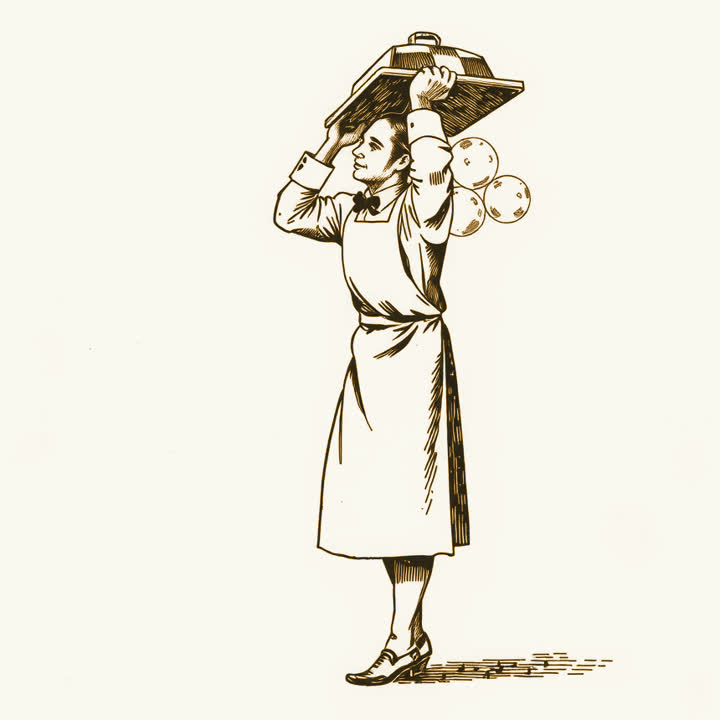
A waiter remembers every order, then forgets it once the bill is paid.
The story goes that a group of psychologists watched their waiter work through a long lunch without writing anything down. Every dish arrived correctly. When one of them came back later for a forgotten coat, the waiter could not recall what any of them had eaten.
1927. Bluma Zeigarnik takes the question into a laboratory.
She gave people a run of small tasks, puzzles and beads and clay. Some they were allowed to finish. Others she interrupted part way through. Afterwards she asked them what they had been doing.
They remembered the unfinished ones about twice as well.
A task you complete gets filed away and closed. A task you were pulled out of stays live, waiting, tugging at your sleeve. That is the Zeigarnik effect.
The honest footnote. Later attempts to repeat it are mixed.
Some studies find it clearly, some find nothing, and the size seems to depend on how much the person wanted to finish. The basic observation has held up better than the exact figure. Treat it as a real tug rather than an iron rule.
You can feel it working on you every evening.
The message you started and left half written. The argument that stopped without ending. The story that breaks off at the cliff edge, which is the entire business model of the cliff edge.
So use the tug instead of fighting it.
Stop a study session in the middle of something you already know how to finish. The open loop keeps working while you walk home, and sitting back down is far easier than starting. Ernest Hemingway said he always stopped for the day when he knew what came next.
And close the loops you cannot use.
An unfinished thing you cannot act on tonight is just noise in the room. Write it somewhere you trust, with the next step on it. Your head lets go of a task the moment it believes something else is holding it.
Sources
- Zeigarnik effect, Wikipedia. Her 1927 experiments with interrupted tasks, the café story behind them, and the mixed record of attempts to reproduce the result since.
- Getting Things Done, David Allen, 2001. A whole working method built on the idea that an unfinished task nags until it is written down somewhere trusted with its next action attached.
- Kurt Lewin, Wikipedia. Zeigarnik’s supervisor, the café observation that started it, and his idea that an unfinished intention leaves a tension in the mind until it is discharged.
Nearby ideas
- The spacing effect. Spread your study out over time and it lasts far longer.
- Desirable difficulties. The practice that feels hardest is often the practice that sticks.
- Parkinson’s law. Work expands to fill the time you give it.
- Dual coding. Words and pictures together stick better than either alone.
- Cognitive load. The mind can juggle only a few new things at once.
- The illusion of competence. Feeling familiar with material is not the same as knowing it.
- The generation effect. Trying to produce an answer first makes it stick, even when you are wrong.
- The learning styles myth. Matching lessons to a preferred style does not improve learning.