Cobra Effect · Learning and memory
Dual coding
Words and pictures together stick better than either alone.
6 cards, read aloud in 2:23, with a test and sources.
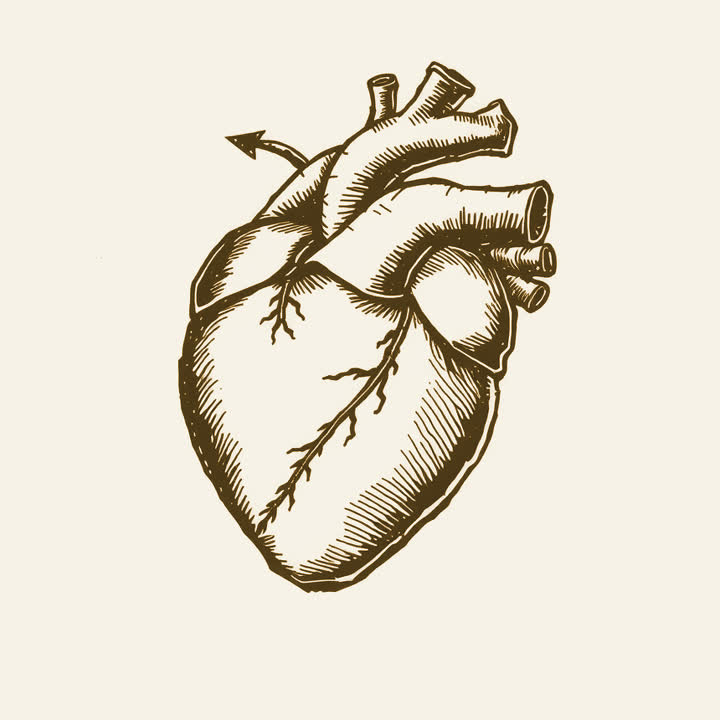
Two students revise the same page on the heart.
One reads it three times and underlines. The other reads it once, then draws the heart from memory, with arrows for the blood. Her drawing is ugly. Her notes are shorter. A week later, she remembers a good deal more.
Allan Paivio spent the 1960s finding out why.
A Canadian psychologist, and once a champion bodybuilder, he ran memory tests with pictures and with words. Pictures were remembered better than words. Concrete words like hammer were remembered better than abstract ones like justice. The difference, he argued, was how many ways the mind could hold each item.
That is dual coding.
His 1971 book laid it out. The mind runs two systems, one for language and one for images. A fact stored in only one system has one way back in. A fact stored in both has two, and each can rebuild the other. A sentence beside a diagram is not decoration. It is a second copy.
It is not about learning styles.
There are no visual learners and verbal learners. Careful studies keep failing to find them. Everybody has both systems, and everybody learns better using both. The student who says she is not a visual person is the student who most needs to draw.
The picture must do work.
Richard Mayer ran dozens of experiments on lessons with and without pictures. A diagram that shows how the thing works helps. A pretty photo dropped in to break up the page does nothing, or hurts. The image and the sentence must say the same thing, side by side, at the same time.
Tonight, draw what you read.
Take one page you need to know. Draw it. A diagram, a timeline, a map of the argument, boxes and arrows. Then put the page away and explain the drawing out loud in sentences. Ugly is fine. You are not making art. You are making a second door.
Sources
- Dual-coding theory, Wikipedia. Paivio’s theory, the two systems, the picture and concreteness findings, and the criticisms. Search Imagery and Verbal Processes, 1971, for the book itself.
- Understanding How We Learn, Yana Weinstein and Megan Sumeracki, 2018. Six strategies from the research, dual coding among them, written for students and teachers by the people behind the Learning Scientists site.
- Picture superiority effect, Wikipedia. The finding that started it. Pictures are remembered better than the same things in words, and the arguments about why.
Nearby ideas
- The method of loci. Pin what you need to remember to a place you already know.
- Chunking. Experts see patterns where beginners see pieces.
- The spacing effect. Spread your study out over time and it lasts far longer.
- Cognitive load. The mind can juggle only a few new things at once.
- The illusion of competence. Feeling familiar with material is not the same as knowing it.
- The generation effect. Trying to produce an answer first makes it stick, even when you are wrong.
- The learning styles myth. Matching lessons to a preferred style does not improve learning.
- Sleep and consolidation. Sleep is when the day’s learning gets filed away.