Cobra Effect · The brain
The patient who could only say tan
How one patient's lost speech pointed to a part of the brain with a special job.
7 cards, read aloud in 2:47, with a test and sources.
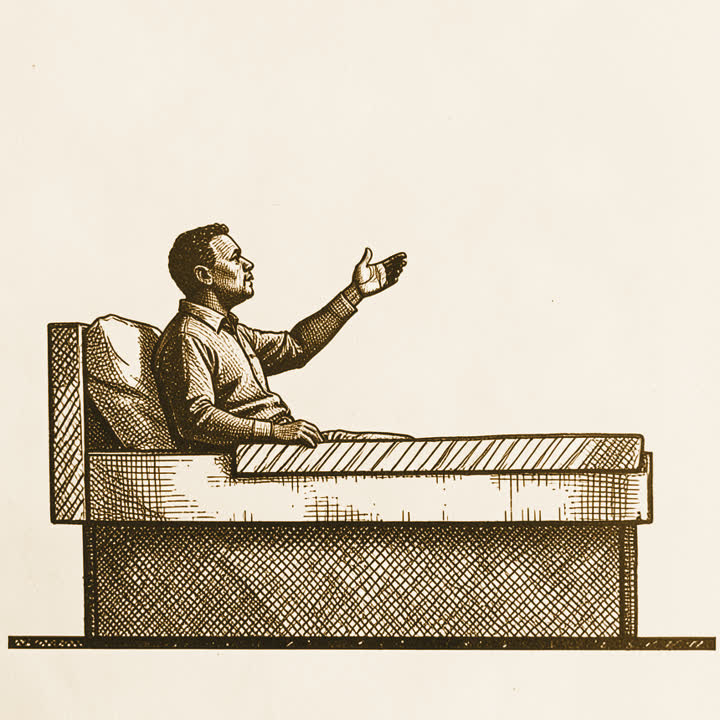
In April 1861, a patient called Tan was moved to the ward of the surgeon Paul Broca, in Paris.
He had spent more than twenty years at the Bicetre hospital. Long before, he had lost the ability to speak, except for one syllable, tan, usually said twice. Yet he understood what was said to him, and answered with gestures. When he was not understood, he grew angry, and added a swear word.
His real name was Louis Victor Leborgne.
On the wards, he was known by the one word he could say. He had epilepsy, and in later years lost the use of his right side. He came to Broca’s ward with a badly infected leg, and died within a week.
Broca examined his brain after he died.
The next day, he showed it to a meeting of scientists who were arguing over whether parts of the brain have separate jobs. There was a damaged area in the left frontal lobe, toward the front of the brain. Broca did not cut into the brain, so that it could be preserved.
Broca suggested that this region was needed for producing speech.
In 1861 he was cautious, placing the damage in a fold of the frontal lobe. Months later, a second patient who had lost his speech showed damage in the same place. By 1865, after more cases, he declared that we speak with the left hemisphere. A little known doctor, Marc Dax, had suggested something similar decades before.
That region is still called Broca’s area.
It lies toward the front of the brain, usually on the left side. Damage there can leave people understanding language, but struggling to produce it. Modern research shows that speech depends on a wider network of brain regions working together.
In 2007, Leborgne’s preserved brain was scanned with modern equipment.
It had been kept in Paris for nearly a century and a half. The scans showed the damage reached much deeper than the surface patch Broca had described. In 2013, a historian traced records of Leborgne’s life, and found that his father had been a schoolteacher.
So when one case seems to reveal how something works, ask what a closer look would add.
One patient launched the idea that parts of the brain have particular jobs. More cases and better tools refined it, and showed it was more complicated. A striking case is a starting point, not the final word.
Sources
- Discovering the Identity of a 150-Year-Old Patient, Smithsonian Magazine. Who Monsieur Leborgne really was.
- Remarks on the seat of the faculty of articulated language, Paul Broca, 1861, English translation. Broca’s own report on the patient.
- Paul Broca’s historic cases: high resolution MR imaging of the brains of Leborgne and Lelong, Brain, 2007, on PubMed. The modern scans of the preserved brains.
Nearby ideas
- Is the brain one net or many cells?. How a black stain and a famous feud revealed that the brain is made of separate cells.
- The man who could not make new memories. How one man's lost memory showed that remembering and learning skills are separate.
- The patients with a divided brain. What patients with a divided brain revealed, and the myth it was stretched into.
- The cells that see edges. How an accident with a glass slide revealed brain cells that detect edges.
- The taxi drivers whose brains changed. How London's taxi drivers showed that intense learning can reshape the adult brain.