Cobra Effect · The brain
Is the brain one net or many cells?
How a black stain and a famous feud revealed that the brain is made of separate cells.
7 cards, read aloud in 2:53, with a test and sources.
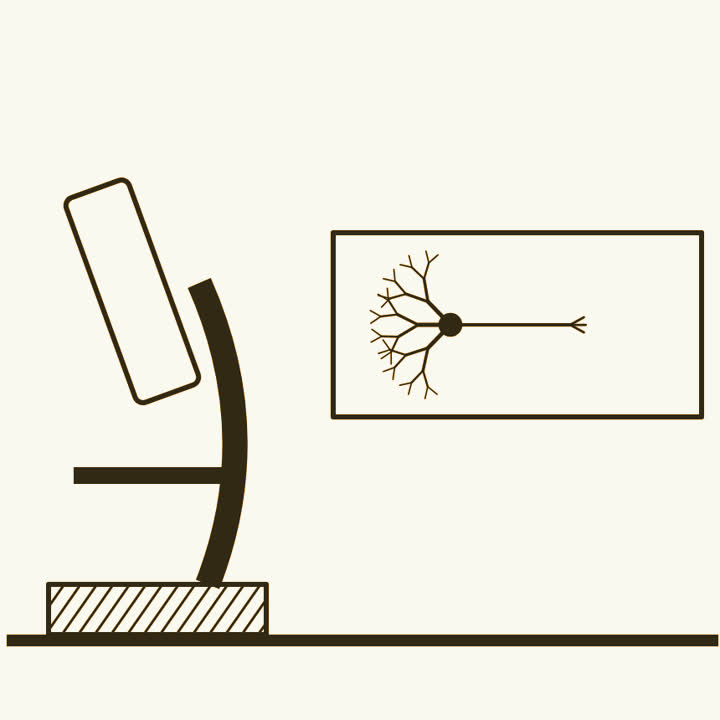
In 1873, Camillo Golgi found a way to stain nerve cells black.
Golgi was an Italian doctor, working at a hospital for the chronically ill. He hardened nerve tissue in one chemical, then soaked it in silver nitrate. Only a few cells turned black, but each one showed completely, down to its finest branches. He called it the black reaction.
Golgi believed the nerve fibres fused together into one continuous net.
Under his microscope, the finest branches seemed to run into one another. He pictured the nervous system as a single joined network. Many scientists agreed with him.
In Spain, Santiago Ramon y Cajal took up Golgi’s stain.
Cajal had wanted to be an artist as a boy, and he drew what he saw with great care. In 1887 he saw slides made with Golgi’s method, and set about improving it. Tracing branch after branch, often in birds and young animals, he followed each one to its end. The branches came close to other cells, but did not join them.
In 1888, Cajal argued that the nervous system is made of separate cells.
Each cell, he said, is a distinct unit, touching others but not fused with them. In 1891 the German anatomist Wilhelm Waldeyer called these cells neurons. The idea became known as the neuron doctrine.
In 1906, Golgi and Cajal shared the Nobel Prize, and used their lectures to disagree.
They were honoured together for their work on the structure of the nervous system. Golgi spoke first, and said he had always been opposed to the neuron theory. The next day, Cajal described nerve cells meeting by contact, not by continuity. Golgi never changed his mind.
In the 1950s, electron microscopes finally settled the argument.
They could show far finer detail than any light microscope. They revealed tiny gaps between nerve cells, where signals pass from one to the next. Cajal’s picture had won. Even so, a few nerve cells are directly joined, just as Golgi might have liked.
So when two experts see the same evidence differently, ask what finer detail could decide it.
Golgi and Cajal used the same stain and saw different things. Their argument could not be settled until a sharper instrument existed. Sometimes the honest answer is to keep looking, and wait for better evidence.
Sources
- The Nobel Prize in Physiology or Medicine 1906, NobelPrize.org. The prize Golgi and Cajal shared, with links to both.
- The neuron doctrine, theory and facts, Camillo Golgi, Nobel lecture, 1906. Golgi’s lecture arguing against separate nerve cells.
- The structure and connexions of neurons, Santiago Ramon y Cajal, Nobel lecture, 1906. Cajal’s reply, the next day.
Nearby ideas
- The patient who could only say tan. How one patient's lost speech pointed to a part of the brain with a special job.
- The man who could not make new memories. How one man's lost memory showed that remembering and learning skills are separate.
- The patients with a divided brain. What patients with a divided brain revealed, and the myth it was stretched into.
- The cells that see edges. How an accident with a glass slide revealed brain cells that detect edges.
- The taxi drivers whose brains changed. How London's taxi drivers showed that intense learning can reshape the adult brain.