Cobra Effect · The brain
The cells that see edges
How an accident with a glass slide revealed brain cells that detect edges.
7 cards, read aloud in 2:44, with a test and sources.
In 1958, David Hubel and Torsten Wiesel began studying how the brain sees.
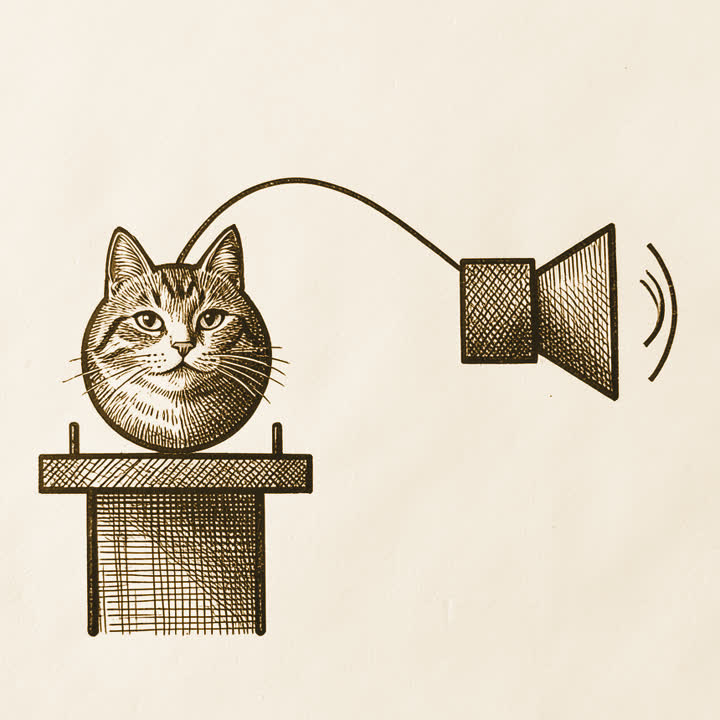
They worked at Johns Hopkins University, in Baltimore. They recorded the electrical signals of single nerve cells in the visual part of a cat’s brain. The cat was anaesthetised, and the signals were played through a loudspeaker as a stream of clicks.
For weeks, the cells barely responded.
They shone spots of light onto the cat’s retina, the way other scientists had studied cells in the eye. The cells in the brain largely ignored them. Once, they held a single cell steady for nine hours, and for hours nothing they tried worked.
Then, as they slid a glass slide into their instrument, the cell burst into life.
The dot on the slide had nothing to do with it. The edge of the glass had cast a faint, sharp line onto the retina. The cell responded to that line, but only when it lay at a particular angle. Hubel later said the cell went off like a machine gun.
They had found brain cells that respond to lines and edges.
Different cells preferred lines at different angles. Other cells combined these signals, building more complex responses. It took months of careful checking before they published, in 1959.
They also found that early experience shapes the visual brain.
In experiments that have since been criticised as cruel, they closed one eyelid of young kittens. Closed during the first months of life, that eye stayed effectively blind even after it was reopened. The same closure in adult cats had no such effect. There was a critical period early in life, when the brain needs normal vision to wire itself.
Their work changed how children’s eye problems are treated.
Babies born with cataracts are now treated early, before that critical period passes. Children with a lazy eye are treated young, often by patching the stronger eye. In 1981, Hubel and Wiesel shared the Nobel Prize in Physiology or Medicine.
So when careful searching finds nothing, ask whether you are testing the right thing.
Spots of light worked in the eye, so they seemed the obvious test for the brain. The breakthrough came when an accident offered a line instead. Noticing it was not just luck. It came after weeks of patient, careful work.
Sources
- Evolution of ideas on the primary visual cortex, 1955 to 1978, David Hubel, Nobel lecture, 1981. Hubel’s own account, including the glass slide.
- The postnatal development of the visual cortex and the influence of environment, Torsten Wiesel, Nobel lecture, 1981. Wiesel on the critical period.
- Receptive fields of single neurones in the cat’s striate cortex, Hubel and Wiesel, 1959. Their first paper on cells that respond to lines.
Nearby ideas
- The patients with a divided brain. What patients with a divided brain revealed, and the myth it was stretched into.
- Is the brain one net or many cells?. How a black stain and a famous feud revealed that the brain is made of separate cells.
- The taxi drivers whose brains changed. How London's taxi drivers showed that intense learning can reshape the adult brain.
- The patient who could only say tan. How one patient's lost speech pointed to a part of the brain with a special job.
- The man who could not make new memories. How one man's lost memory showed that remembering and learning skills are separate.