Cobra Effect · The brain
The patients with a divided brain
What patients with a divided brain revealed, and the myth it was stretched into.
7 cards, read aloud in 2:47, with a test and sources.
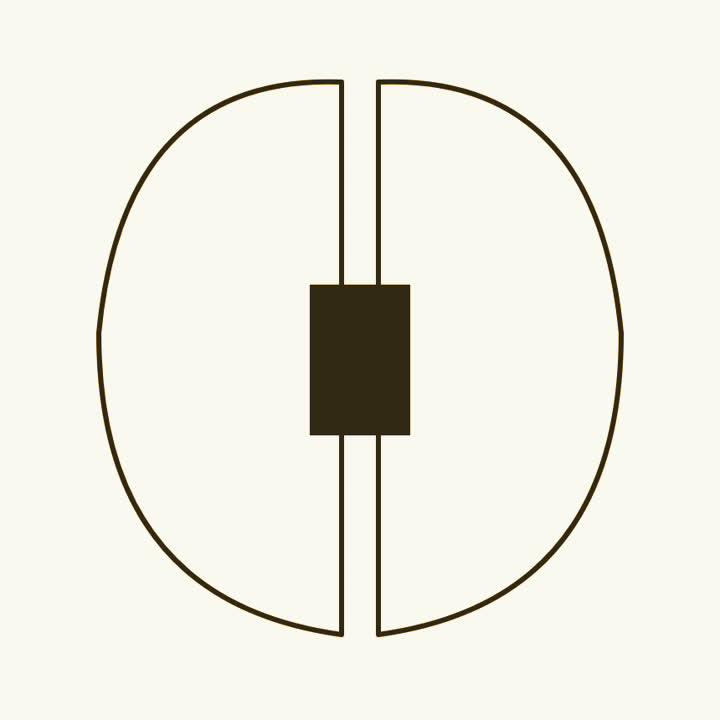
In the 1950s, Roger Sperry studied animals whose brain halves had been disconnected.
The two halves of the brain are joined by a thick band of fibres called the corpus callosum. At Caltech, Sperry’s team cut these connections in cats and monkeys. Each half could then learn a task on its own, without the other half knowing.
In 1962, surgeons cut these connections in a man with severe epilepsy.
Philip Vogel and Joseph Bogen hoped to stop seizures spreading from one side of his brain to the other. The patient was a war veteran whose seizures could not otherwise be controlled. In everyday life, he seemed remarkably normal afterwards.
Michael Gazzaniga, a graduate student in Sperry’s lab, tested him carefully.
The left half of the brain sees what is on the right side of view, and the right half sees the left side. In most people, speech is handled mainly by the left half. So Gazzaniga flashed pictures briefly to one side only, while the patient looked at a dot in the middle.
When a picture flashed on the left side, the patient could not say what he had seen.
Only the right half of his brain had seen it, and that half could not speak. Yet his left hand, which the right half controls, could pick out the matching object by touch. Pictures flashed on the right side, he could name at once.
Each half of the brain seemed to have abilities of its own.
The left half usually handled language. The right half was often better at some tasks involving shapes and space. Later work found the speaking half would make up explanations for actions the other half had started. Sperry shared the Nobel Prize in Physiology or Medicine in 1981.
The results were later stretched into a popular myth.
Magazines began describing people as left brained and logical, or right brained and creative. But a 2013 study of more than a thousand people’s brain scans found no sign that people favour one half overall. Particular abilities lean to one side, but everyone uses both halves all the time.
So when a finding becomes a catchy label, ask what the original experiment really showed.
Sperry and Gazzaniga studied a small number of unusual patients. Their careful tests revealed how the two halves divide some of their work. They never showed that personalities come in left and right types.
Sources
- Some functional effects of sectioning the cerebral commissures in man, Gazzaniga, Bogen and Sperry, 1962. The first report on the split-brain patient.
- The Split Brain Experiments, NobelPrize.org. How the experiments worked, explained for a general reader.
- An evaluation of the left-brain vs. right-brain hypothesis, PLOS ONE, 2013. The study of more than a thousand brain scans.
Nearby ideas
- The patient who could only say tan. How one patient's lost speech pointed to a part of the brain with a special job.
- The man who could not make new memories. How one man's lost memory showed that remembering and learning skills are separate.
- The cells that see edges. How an accident with a glass slide revealed brain cells that detect edges.
- The taxi drivers whose brains changed. How London's taxi drivers showed that intense learning can reshape the adult brain.
- Is the brain one net or many cells?. How a black stain and a famous feud revealed that the brain is made of separate cells.