Cobra Effect · People and organisations
Broken windows theory
Visible neglect invites more of it, though the crime claims are contested.
7 cards, read aloud in 2:37, with a test and sources.
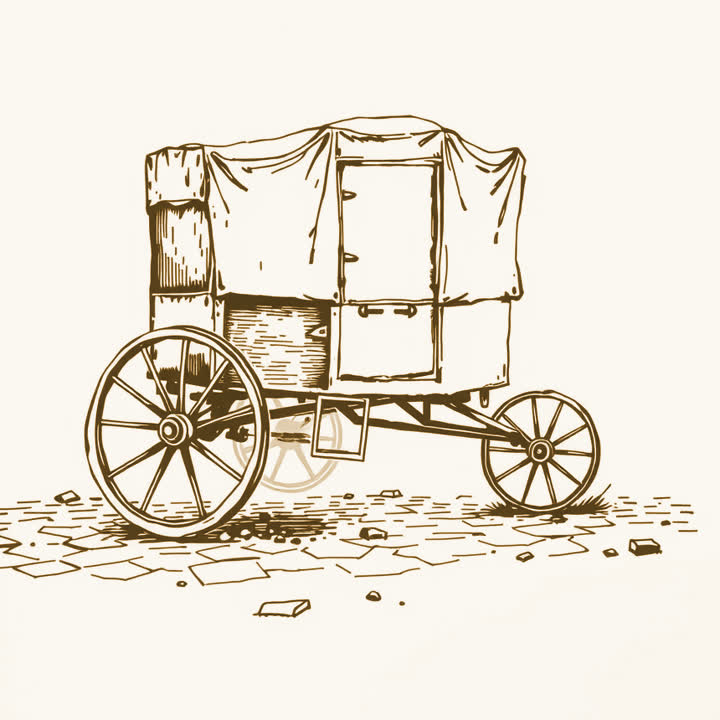
A car is left with its bonnet up in the Bronx. Another in Palo Alto.
Philip Zimbardo ran it in 1969. The Bronx car was stripped within a day. The Palo Alto car sat untouched for a week, so Zimbardo smashed a window himself. Within hours people passing were tearing it apart.
In 1982 two social scientists built a theory on that.
James Q. Wilson and George Kelling wrote a piece called Broken Windows for The Atlantic Monthly. One unrepaired window says nobody here is watching. So the next window costs nothing to break.
The claim is about signals, not about glass.
Litter, graffiti, a burnt out cart, a door nobody ever fixes. Wilson and Kelling argued that visible disorder tells people the rules here are not enforced. Ordinary residents then stay indoors, and the street belongs to whoever is left on it.
New York picked it up, and crime fell.
Through the 1990s the city went hard at fare dodging, graffiti and public drinking. Violent crime dropped a very long way over that decade. The theory got the credit, and the credit made it famous.
And this is where the story needs to slow down.
Crime fell across the United States in the 1990s, including in cities that did nothing of the kind. In 2006 Bernard Harcourt and Jens Ludwig looked for the pattern in a large housing experiment and did not find it. The fall has several competing explanations and no agreed winner.
The policing that came with it had a bill attached.
Enforcing small things at scale meant stopping and searching a great many people who had done nothing. Kelling himself said later that the idea had been turned into something he never intended. A theory about repairing a street became a warrant to stop its residents.
What survives, and what to do with it.
The narrow version has support. A place that looks cared for tends to get treated with more care. Repairing the broken thing is cheap, quick, and harms nobody. The wide version, that arresting people for small things cuts serious crime, is not settled. So fix the window. Be much slower to arrest the neighbourhood.
Sources
- Broken Windows, James Q. Wilson and George L. Kelling, 1982. The original article in The Atlantic. Shorter and far more careful than its reputation, and the place where Zimbardo’s abandoned cars appear.
- Illusion of Order, Bernard Harcourt, 2001. The sustained case against the theory as crime policy, by the scholar who later went looking for the pattern in a large housing experiment and did not find it.
- Broken windows theory, Wikipedia. The theory, the New York years, and a long section on the studies for and against. The best short way to see how contested the evidence still is.
Nearby ideas
- Feedback loops. Why some systems spiral out of control and others settle down.
- The Pygmalion effect. What we expect of people quietly shapes what they become.
- The replication crisis. Why many famous findings vanished when others tried them again.
- Parkinson’s law. Work expands to fill the time you give it.
- The Peter principle. Why people get promoted until they reach a job they cannot do.
- Brooks’s law. Adding people to a late project makes it later.
- Conway’s law. Systems end up shaped like the teams that build them.
- The Hawthorne effect. Being watched changes what people do, and muddies what you measure.