Cobra Effect · People and organisations
The Peter principle
Why people get promoted until they reach a job they cannot do.
5 cards, read aloud in 1:29, with a test and sources.
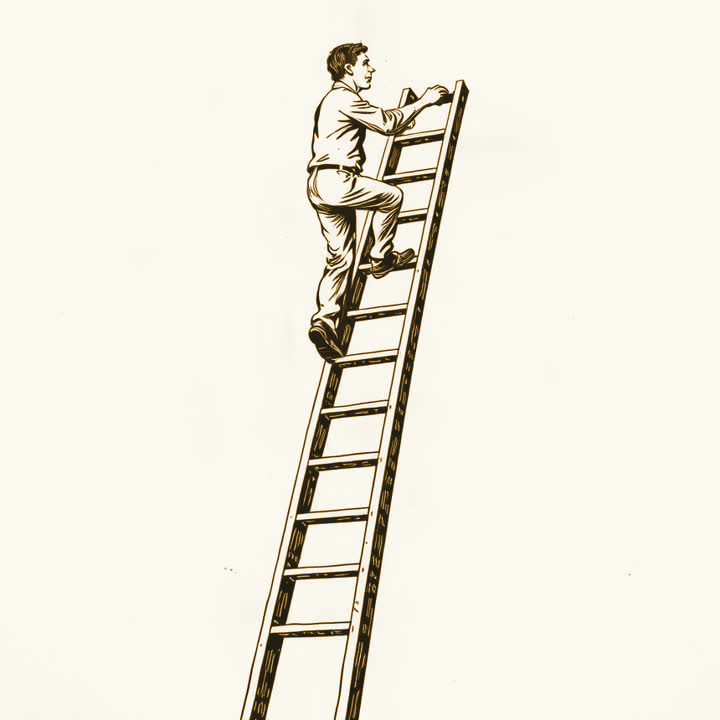
People rise to their level of incompetence.
Laurence Peter, 1969. In a hierarchy, you get promoted for doing your current job well. You keep getting promoted until you reach a job you do badly. Then you stop. And you stay there.
The best salesperson becomes a sales manager.
Selling and managing salespeople are different skills. The promotion was a reward for the first. It was a bet on the second, and nobody checked.
Which means every organisation fills up with people who are stuck.
Not because they are bad. Because the last promotion was the first one they couldn’t grow into. The work still gets done by the people who haven’t been promoted yet.
Peter meant it as satire. The data mostly agrees with him.
A 2018 study of sales staff found the best sellers were the most likely to be promoted, and their teams then did worse under them. Firms were promoting on the last job, not the next one.
The fixes are simple and rarely done.
Promote on evidence for the next job, not performance in the last one. Pay senior specialists like managers, so promotion isn’t the only raise. And let people step back down without shame.
Sources
- Promotions and the Peter Principle, Alan Benson, Danielle Li and Kelly Shue, 2018. The study in the story. Sales data from over two hundred firms, showing the best sellers were the most likely to be promoted, and that their teams did worse under them. The NBER page has the abstract and the paper.
- The Peter Principle, Laurence J. Peter and Raymond Hull, 1969. The satire that named it. Written as mock social science and funnier than it needs to be. Peter’s Wikipedia page has the story of how it came to be written.
- Peter principle, Wikipedia. The idea, the responses to it, and the later research that took a joke seriously and found it was mostly true.
Nearby ideas
- Parkinson’s law. Work expands to fill the time you give it.
- The Dunning Kruger effect. Why the least skilled are often the worst judges of their skill.
- Brooks’s law. Adding people to a late project makes it later.
- Conway’s law. Systems end up shaped like the teams that build them.
- The Hawthorne effect. Being watched changes what people do, and muddies what you measure.
- Dunbar’s number. Why groups stop working the old way once they pass about 150.
- The bystander effect. The more people who see a problem, the less each one acts.
- The fundamental attribution error. We blame people’s character and overlook their situation.