Cobra Effect · Incentives and systems
Feedback loops
Why some systems spiral out of control and others settle down.
6 cards, read aloud in 2:39, with a test and sources.
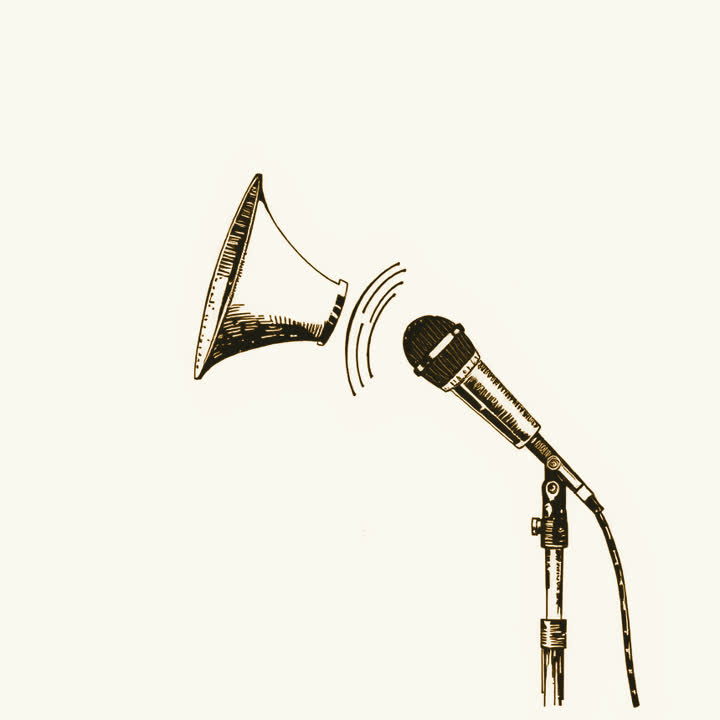
A singer steps too close to the speaker. The room screams.
The microphone hears the speaker. The speaker plays what the microphone heard, louder. The microphone hears that. In under a second the squeal is all there is.
A thermostat does the opposite. It fights whatever happens.
The room gets cold, so the heater comes on. The room gets warm, so the heater goes off. Every change produces a push the other way. The room settles, and stays settled, with nobody watching it.
Two loops. One runs away, one settles.
A feedback loop is any system where the output comes back round as input. A reinforcing loop amplifies. More makes more. Interest on interest, panic in a bank queue, the squeal. A balancing loop corrects. More makes less. The thermostat, a thirsty body, a price that falls until buyers appear. Donella Meadows, who taught systems thinking for decades, called them reinforcing and balancing loops.
James Watt built a balancing loop out of brass in 1788.
His centrifugal governor spins with the engine. Spin too fast and the weights fly outward, closing the steam valve. Slow down and they drop, opening it. The engine holds its speed with no one watching. Norbert Wiener built a whole science on the idea in 1948 and called it cybernetics.
Reinforcing loops are why things go from fine to disaster in a week.
A rumour that a bank is short of cash sends customers to withdraw, which makes the bank short of cash. A team that misses a deadline cuts testing, ships bugs, and spends the next month fixing them, so it misses the next deadline. Each turn makes the next turn stronger. Nothing about the loop is dramatic. The result is.
Ask which loop you are inside.
When something is growing or collapsing, look for the loop feeding it. To stop a runaway, break the loop. Step away from the speaker. To hold something steady, build a balancing loop. A measure, a comparison, a correction. And when you build a system, ask what it feeds back into itself. That is what it will become.
Sources
- Feedback, Wikipedia. Positive and negative feedback, Watt’s governor, the cybernetics of Norbert Wiener, and where the two kinds of loop show up in biology, electronics and economics.
- Thinking in Systems, Donella Meadows, 2008. The primer, published after her death. Stocks, flows, balancing and reinforcing loops, and why systems surprise us. Her 1999 essay Leverage Points is the short version and is free online.
- Centrifugal governor, Wikipedia. The brass balls on Watt’s engine, how they close the valve, and how a machine from 1788 became the textbook picture of a balancing loop.
Nearby ideas
- Second order effects. Every fix has consequences, and those have consequences too.
- Network effects. Why the biggest network tends to swallow the rest.
- The Cobra effect. Why paying for a result can breed more of the problem.
- The race to the bottom. When rivals keep undercutting each other, everybody loses.
- The winner’s curse. Win an auction for something uncertain and you probably overpaid.
- Externalities. Why things get overdone when someone else pays part of the cost.
- Schelling’s segregation model. Mild preferences can add up to a sharply divided world.
- The Red Queen effect. When everyone improves at once, running hard only keeps you in place.