Cobra Effect · People and organisations
The bystander effect
The more people who see a problem, the less each one acts.
7 cards, read aloud in 2:43, with a test and sources.
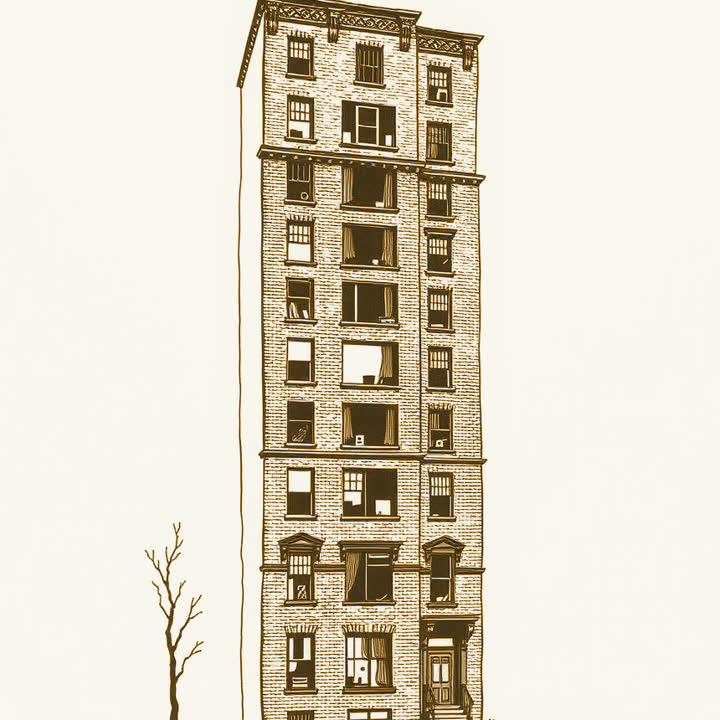
New York, March 1964. A woman is murdered outside her apartment.
Her name was Kitty Genovese. Two weeks later the New York Times reported that 38 neighbours had watched from their windows for half an hour and done nothing. The story went round the world. It was mostly wrong.
What actually happened.
Far fewer people saw anything, and the attack happened in two places. At least one neighbour shouted and scared the attacker off the first time. Someone did call the police. A friend ran down and held Kitty as she died. The Times later admitted its account was flawed.
But the story had already done its work.
Two psychologists, John Darley and Bibb Latané, read it and asked a better question. Not why were people so callous. But what does being one of many do to a person? In 1968 they ran the experiment.
A stranger has a seizure over the intercom.
Students talked to each other through intercoms from separate rooms. One voice, an actor, began to choke and call for help. When a student believed they were the only one listening, 85% went for help. When they believed four others could hear too, 31% did. The more people who could help, the less likely any one of them did.
That is the bystander effect.
Responsibility divides by the number of people present. Everyone assumes someone else will act, or that since nobody is acting, it must be fine. In another study, smoke poured into a room. Alone, three quarters of people reported it. Sitting with two calm strangers, one in ten did.
One more twist. In the real world, people mostly do help.
In 2019 researchers went through CCTV footage of real street fights in three countries. In nine cases out of ten, someone stepped in. The effect is real in the lab. On the street, being in a group also means someone is likely to move.
So if you need help, pick one person.
Don’t shout for someone to call an ambulance. Point. You, in the red coat, call an ambulance. And when you are the bystander, remember that the crowd is waiting for the crowd. Be the one it was waiting for.
Sources
- Murder of Kitty Genovese, Wikipedia. The corrected account. What the neighbours saw and did, how the 38 witnesses story was built, and how the New York Times came to admit its errors.
- The Unresponsive Bystander: Why Doesn’t He Help?, Bibb Latané and John Darley, 1970. The two researchers on their own experiments, the seizure and the smoke among them. Out of print but findable in libraries.
- Bystander effect, Wikipedia. The experiments since 1968, the conditions that weaken the effect, and the CCTV studies showing that in real conflicts someone usually intervenes.
Nearby ideas
- Dunbar’s number. Why groups stop working the old way once they pass about 150.
- Brooks’s law. Adding people to a late project makes it later.
- Parkinson’s law. Work expands to fill the time you give it.
- The fundamental attribution error. We blame people’s character and overlook their situation.
- The Abilene paradox. How a group can agree to something that nobody wants.
- The Pygmalion effect. What we expect of people quietly shapes what they become.
- Groupthink. How close, loyal teams talk themselves into bad decisions.
- Asch’s conformity experiments. Why people go along with a group they can see is wrong.