Cobra Effect · Science and philosophy
Cargo cult science
Science can copy every outward form and still miss the honesty.
7 cards, read aloud in 2:60, with a test and sources.
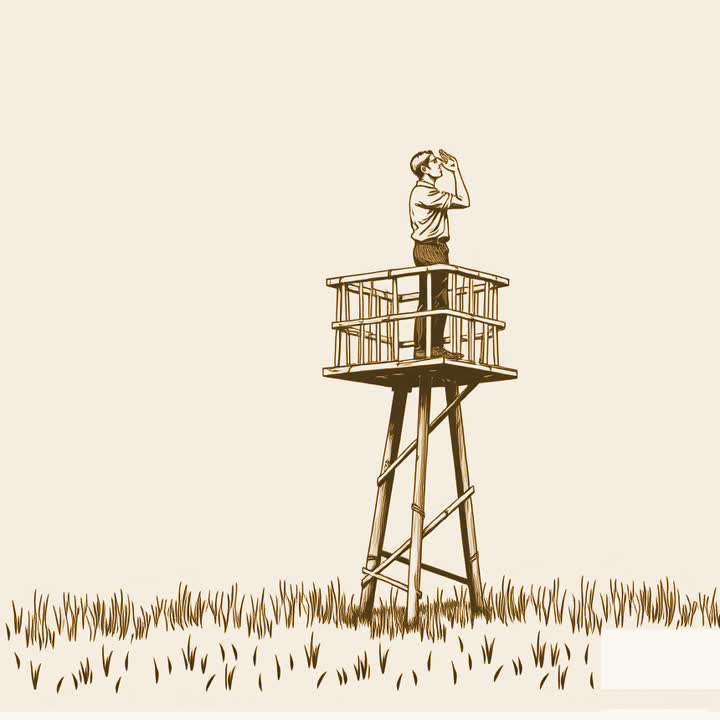
The war ends, and the planes stop coming.
During the war, aircraft landed on some Pacific islands full of food and goods. After it, they stopped. So, in the story Richard Feynman told, the islanders built runways. Fires along the sides. A wooden hut. A man inside with wooden headphones and bamboo antennas, waiting.
The form is perfect. The planes don’t land.
Feynman used the picture in his 1974 commencement address at Caltech. He wasn’t mocking the islanders. He was mocking scientists. There is research, he said, that has every outward form of science and lacks the thing that makes it work. He called it cargo cult science.
The missing thing is a kind of honesty that leans over backwards.
Report everything you think might make your result wrong, not just what supports it. Report the results that didn’t come out, and the other explanations you couldn’t rule out. Give every detail someone would need to show you were mistaken. Feynman’s line, the one people remember: you must not fool yourself, and you are the easiest person to fool.
His example is Millikan’s electron.
Robert Millikan measured the charge on the electron in the 1910s and got it slightly wrong. Every measurement after his crept upward, a little at a time, toward the true value. Why not a jump? Because whenever someone got a number far above Millikan’s, they assumed they had erred and went looking for the mistake. When they got a number close to his, they stopped looking.
And the rats that could hear the floor.
In 1937, Feynman said, a man named Young found that rats in a maze were learning the right door from the sound of the corridor floor. He put the maze on sand and the rats had to learn properly. Then Feynman checked. Nobody who ran rat mazes afterwards cited him or used the sand. Young had found out how to do the experiment right. Everyone else kept building runways.
A note on the name.
Cargo cult is an old term for the island movements, and anthropologists now consider it dated and unfair to the people it describes. Feynman’s target was never them. It was the laboratory with the perfect form and the missing honesty. Keep the lesson. Hold the picture lightly.
The test for your own work.
Before you show a result, write down the three things that could make it wrong. Then show those first. If you cannot think of any, you have not looked. The runway is easy. The planes only come for the honest.
Sources
- Cargo Cult Science, Richard Feynman, Caltech, 1974. The address itself, on Caltech’s own site. Short, funny and still the best statement of what scientific honesty asks of you. The Millikan and rat maze stories are both here.
- Surely You’re Joking, Mr. Feynman!, Richard Feynman, 1985. The memoir that ends with this address as its final chapter. Safecracking, samba and bongo drums first, then the sermon.
- Cargo cult, Wikipedia. The island movements behind the metaphor, what they actually were, and why anthropologists now find the term reductive.
Nearby ideas
- The replication crisis. Why many famous findings vanished when others tried them again.
- Falsifiability. A claim that nothing could disprove tells you nothing.
- Confirmation bias. We look for evidence that agrees, and rarely test what could say no.
- Fermi estimation. Break an impossible question into small guesses you can make.
- Absence of evidence. Finding nothing only counts if you would have found it.
- Clarke’s third law. Advanced technology can look like magic, and so can a good trick.
- Schrodinger’s cat. A thought experiment built to show where the quantum rules run out.
- The veil of ignorance. Write the rules as if you did not know which seat you would get.