Cobra Effect · Science and philosophy
Schrodinger’s cat
A thought experiment built to show where the quantum rules run out.
6 cards, read aloud in 2:31, with a test and sources.
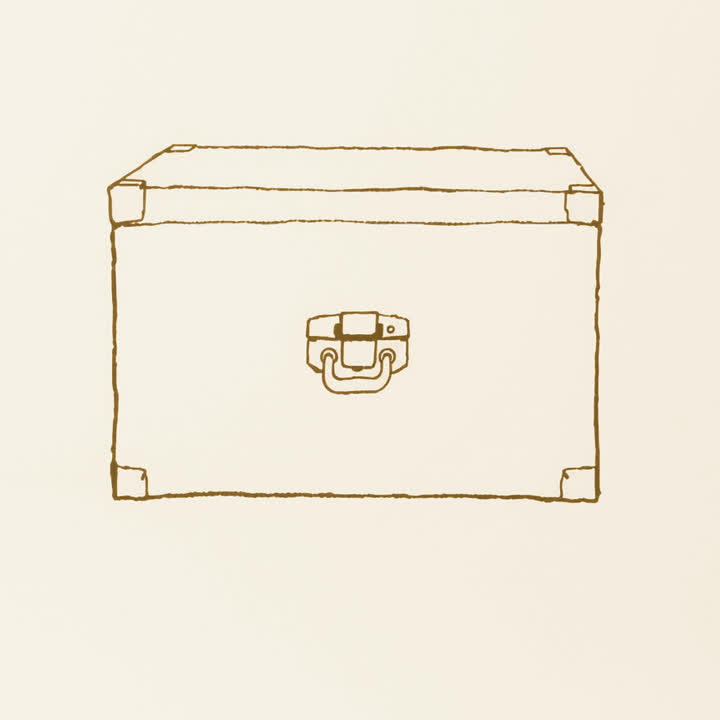
A physicist describes a box with a cat in it, and he is not being cute.
Inside the box, a tiny amount of radioactive material. Within an hour one atom may decay, or may not. If it does, a counter trips a hammer, the hammer breaks a flask of acid, and the cat dies. Erwin Schrodinger published this in 1935. He was not illustrating the theory. He was mocking it.
The theory said the atom sits in both states until it is measured.
Decayed and undecayed at once, in what physicists call a superposition. Fine for an atom that nobody can see. Schrodinger tied the atom to a cat and asked whether anyone believed the cat was in both states too. He called the case ridiculous, and he meant it.
The question underneath is where measurement begins.
The rules work beautifully for small things and have never been seen to hold for cats. So something changes on the way up, and nobody agreed where. Is it the counter, the hammer, the cat, or the physicist opening the lid? That boundary is what the cat was built to expose.
Einstein liked it, because he had the same complaint.
The two men wrote to each other about it that year. Einstein had his own version, with gunpowder that might or might not have exploded. Neither man thought the theory was wrong. They thought the story told about it was incomplete.
Ninety years on, the cat is still doing its job.
Physicists have shown interference with objects far bigger than atoms, including molecules built from 60 carbon atoms. Nothing that size is a cat, and the gap is enormous. The usual modern answer is that a large object gets tangled up with its surroundings almost instantly, and the strangeness leaks away. That explains what we see. It does not settle what is real.
So when a thought experiment gets quoted at you, ask who built it.
The cat is usually offered as proof that reality is fuzzy until somebody looks. It was invented by a man who thought that idea was absurd, and who said so in print. An argument turned into a slogan has usually been turned around on the way.
Sources
- The Present Situation in Quantum Mechanics, Erwin Schrodinger, 1935. The paper with the cat in it, written as an objection. Search the title for translations. This page has the setup, the remark about a ridiculous case, and the arguments since.
- In Search of Schrodinger’s Cat, John Gribbin, 1984. The popular history of quantum mechanics that made the cat a household animal. Clear on the physics and on the people. This is the author’s page.
- Measurement in Quantum Theory, Stanford Encyclopedia of Philosophy. The measurement problem set out properly, including where the main interpretations draw the line and what each of them has to give up for it.
Nearby ideas
- The ship of Theseus. Replace every part, and ask whether it is still the same thing.
- The map is not the territory. Every model leaves something out, and that is where it fails.
- Falsifiability. A claim that nothing could disprove tells you nothing.
- The veil of ignorance. Write the rules as if you did not know which seat you would get.
- Pascal’s wager. When a small cost seems to buy protection from an endless loss.
- Kuhn’s paradigm shifts. How science changes, not step by step, but by revolution.
- Galileo’s ship. Why you cannot feel steady motion from the inside.
- Eratosthenes measures the Earth. How a shadow and some arithmetic measured the size of the Earth.