Cobra Effect · Science and philosophy
Fermi estimation
Break an impossible question into small guesses you can make.
7 cards, read aloud in 2:33, with a test and sources.
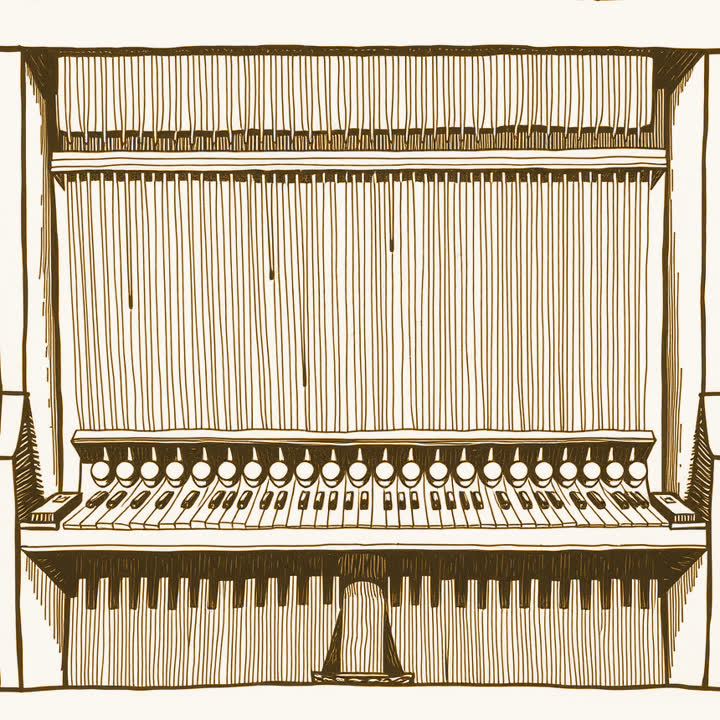
How many piano tuners are there in Chicago?
You do not know. Nobody in the room knows. Enrico Fermi used to set his students questions like this, with no reference book allowed. Guessing the answer is not the point. Breaking it up is.
You cannot know the answer. You can know the pieces.
About three million people live in Chicago. Say a few people to a household, and perhaps one household in twenty owns a piano that gets tuned. A piano is tuned about once a year. A tuner can do a few in a day, for a few hundred days a year.
Multiply it out and you get something you can defend.
Tens of thousands of pianos needing tuning each year, and each tuner managing several hundred of them. That lands you somewhere around a hundred tuners. Not exact. Also not out by a factor of a thousand, and that is the whole trick.
The reason the errors behave themselves.
Each piece you guess is a bit high or a bit low. Independent errors tend to pull against each other rather than pile up in the same direction. Five rough guesses multiplied together usually beat one confident guess at the whole thing.
July 1945. Fermi watches the first atomic bomb go off.
As the blast wave reached him he dropped a handful of torn paper scraps and watched how far the wind carried them. From that alone he worked out the energy of the explosion on the spot. He said about ten kilotons. The careful analysis afterwards came out at roughly twice that.
This is Fermi estimation, and it is a tool for deciding.
Most questions that feel unanswerable are made of pieces you can size. You are not chasing the right answer. You are after the right size, quickly, before the meeting ends. A rough number you can explain beats a precise number nobody has checked.
Try one before you look anything up.
How much milk does your town drink in a day? Write the pieces, guess each one, multiply, and only then go and check. You will be wrong. You will also find out which guess was wrong, which no single number ever tells you.
Sources
- Fermi problem, Wikipedia. The piano tuners, the paper scraps at the first atomic test, and why multiplying several rough guesses tends to land close to the truth.
- Innumeracy, John Allen Paulos, 1988. A short, sharp book on what goes wrong when people cannot handle numbers, with estimation as the everyday cure for it.
- Trinity nuclear test, Wikipedia. The July 1945 test itself, including Fermi dropping scraps of paper as the blast wave passed and reading the yield off how far they blew.
Nearby ideas
- The planning fallacy. Why projects nearly always take longer than we plan.
- Bayesian updating. Change your mind in proportion to the strength of the evidence.
- The map is not the territory. Every model leaves something out, and that is where it fails.
- Absence of evidence. Finding nothing only counts if you would have found it.
- Clarke’s third law. Advanced technology can look like magic, and so can a good trick.
- Schrodinger’s cat. A thought experiment built to show where the quantum rules run out.
- The veil of ignorance. Write the rules as if you did not know which seat you would get.
- Pascal’s wager. When a small cost seems to buy protection from an endless loss.