Cobra Effect · Science and philosophy
Clarke’s third law
Advanced technology can look like magic, and so can a good trick.
7 cards, read aloud in 2:26, with a test and sources.
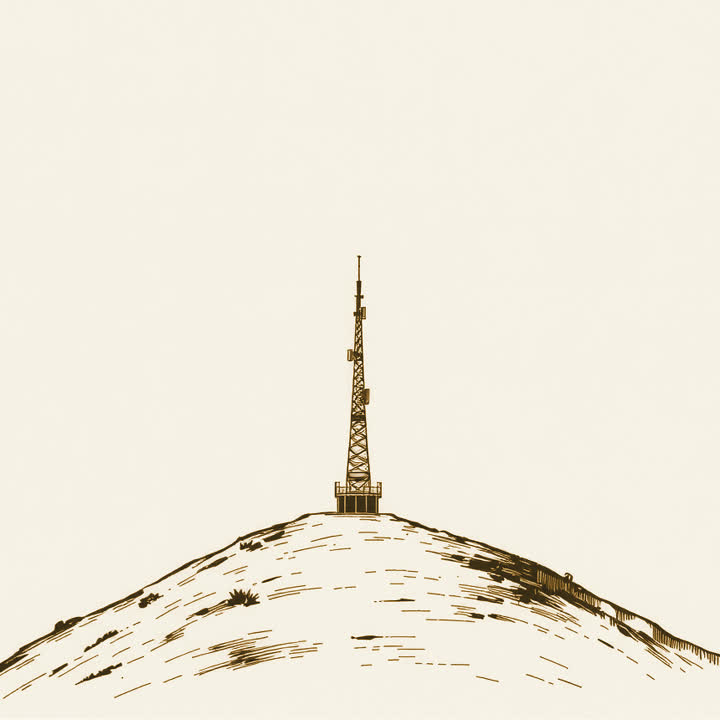
1945. A man who spent the war on radar describes satellites nobody has launched.
Arthur C. Clarke writes the idea up for a magazine called Wireless World. Put a relay high enough in the right orbit and it hangs over one spot on earth. Three of them would cover the planet. The first one flew 19 years later.
He collected rules about prediction, and the third one stuck.
Any sufficiently advanced technology is indistinguishable from magic. He published it in a letter in 1968 and added it to his book in 1973. Three laws were good enough for Newton, he wrote, so he stopped there.
Imagine carrying a small electric lamp into the year 1400.
No flame, no smoke, light from a glass bulb at the touch of a switch. You could explain it honestly and be believed by nobody. The gap between what you can do and what they can explain is the whole of magic.
His first two laws are about the word impossible.
When a distinguished elderly scientist says something is possible, Clarke wrote, he is almost certainly right. When he says it is impossible, he is very probably wrong. And the only way to find the limits of the possible is to go a little way past them into the impossible.
Here is what the third one does to your judgement.
If you cannot tell advanced work from a trick, you cannot tell a working system from a good demonstration. Magic is precisely the thing you are not allowed to look behind. Which makes it a lovely place to hide a fraud.
It cuts the other way too.
Treat something as magic and you stop asking how it works, what it costs and when it fails. Every technology has an inside, a bill and a way of breaking. The wonder is fine. The incuriosity is not.
So ask the question a magician hates.
How would I tell this apart from a trick? What does it look like when it does not work as advertised? Clarke was right that the marvels are real. He never said stop looking.
Sources
- Clarke’s three laws, Wikipedia. All three laws, where each was first published, and the long list of variations the third one has inspired.
- Profiles of the Future, Arthur C. Clarke, 1962. The essay collection the laws live in, written as an inquiry into the limits of the possible. The third law was added in the 1973 revision.
- Geostationary orbit, Wikipedia. The orbit Clarke described in 1945 and how satellites came to sit in it, which is why it is sometimes named after him.
Nearby ideas
- The illusion of explanatory depth. We think we know how things work until we try to explain them.
- Cargo cult science. Science can copy every outward form and still miss the honesty.
- Amara’s law. We overrate new technology in the short run and underrate it in the long.
- Schrodinger’s cat. A thought experiment built to show where the quantum rules run out.
- The veil of ignorance. Write the rules as if you did not know which seat you would get.
- Pascal’s wager. When a small cost seems to buy protection from an endless loss.
- Kuhn’s paradigm shifts. How science changes, not step by step, but by revolution.
- Galileo’s ship. Why you cannot feel steady motion from the inside.