Cobra Effect · Genetics
Scissors that find their own place
How a bacterial defence against viruses became a tool for editing genes.
7 cards, read aloud in 3:27, with a test and sources.
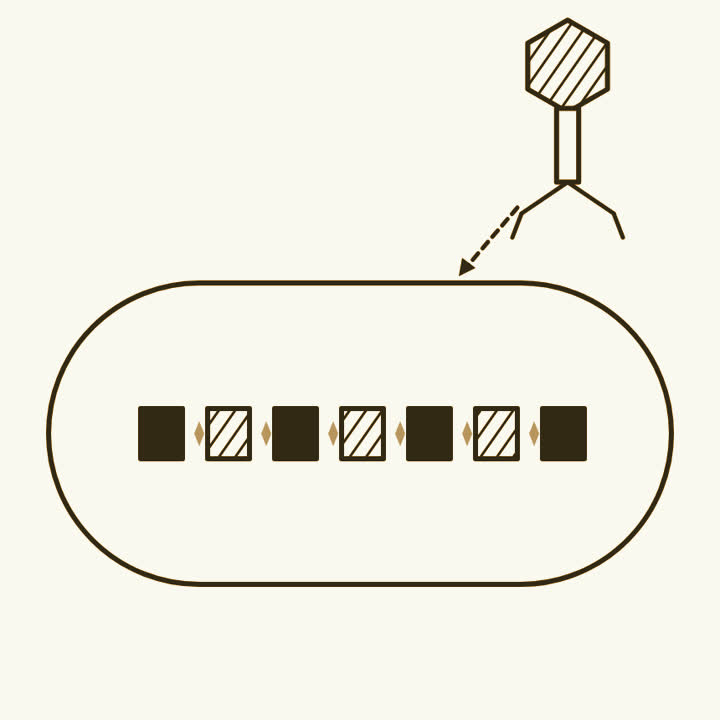
Bacteria fight viruses by remembering them.
Viruses that infect bacteria are everywhere, and bacteria have evolved defences against them. Some bacteria keep short snippets of DNA from viruses that attacked them, stored in a row in their own genome. Scientists named these repeating stretches CRISPR. If the same virus comes back, the bacterium can recognise it.
A protein called Cas9 uses those snippets to find a virus and cut it.
The bacterium copies a stored snippet into a guide made of RNA. Cas9 carries the guide, and searches the virus’s DNA for the stretch that matches it. When it finds the match, Cas9 cuts right through the DNA. The cut virus can no longer take over the cell.
In 2012, Emmanuelle Charpentier and Jennifer Doudna turned it into a tool.
They showed that Cas9, led by a guide RNA, would cut DNA at a place of their choosing. Change the guide, and the scissors go somewhere else. Their paper was published in the journal Science in August 2012. Editing a chosen spot in a genome suddenly became far easier.
In 2020 Charpentier and Doudna shared the Nobel Prize in Chemistry.
The prize was for developing a method for editing genomes. By then, laboratories around the world were using CRISPR in plants, animals and human cells. It had become one of the most widely used tools in biology. One of its first great tests in medicine was a disease of the blood.
In sickle cell disease, a single change in one gene bends red blood cells.
Healthy red blood cells are round and flexible. In sickle cell disease they can become stiff and curved, and block small blood vessels, causing severe pain. Babies make a different kind of haemoglobin, called fetal haemoglobin, which does not sickle. Normally, a genetic switch turns fetal haemoglobin off after birth.
In 2023 the first CRISPR treatment was approved, for sickle cell disease.
Doctors take a patient’s own blood stem cells and edit them in a laboratory. The edit takes the brakes off fetal haemoglobin, and the cells are returned to the patient. The UK approved the treatment, called Casgevy, in November 2023, and the United States followed in December. Victoria Gray, the first patient treated in a trial in 2019, had often been rushed to hospital. Since then she has had no crises.
So when a tool can rewrite life, ask who decides how it is used.
In 2018 the Chinese scientist He Jiankui announced that twin girls had been born from embryos whose genes he had edited. Scientists around the world condemned the experiment as unsafe and unethical. In 2019 a Chinese court sentenced him to three years in prison. The same scissors that can treat a disease raise hard questions about changing the genes that children inherit.
Sources
- The Nobel Prize in Chemistry 2020: popular information, NobelPrize.org. How bacterial genetic scissors became a tool for editing genomes.
- A programmable dual-RNA-guided DNA endonuclease in adaptive bacterial immunity, Jinek, Charpentier, Doudna and colleagues, Science, 2012. The paper showing Cas9 could be guided to cut chosen DNA.
- U.K. approves world’s first CRISPR-based medicine, STAT News, 2023. The approval of Casgevy for sickle cell disease and beta thalassaemia.
Nearby ideas
- The shape that explained heredity. How an X-ray photograph and a chemical rule revealed the double helix of DNA.
- Reading the whole book of a human. How reading all three billion letters of human DNA changed what we know about ourselves.
- The pattern only you carry. How patterns of DNA bands reunited a family and solved a murder.
- Peas that counted. How a friar counted thousands of peas and found the rules of inheritance.
- The fly with white eyes. How one white-eyed fly showed that genes sit on chromosomes.
- Genes are made of DNA. How dead bacteria, a purified extract and a kitchen blender showed genes are made of DNA.