Cobra Effect · Genetics
Peas that counted
How a friar counted thousands of peas and found the rules of inheritance.
7 cards, read aloud in 3:20, with a test and sources.
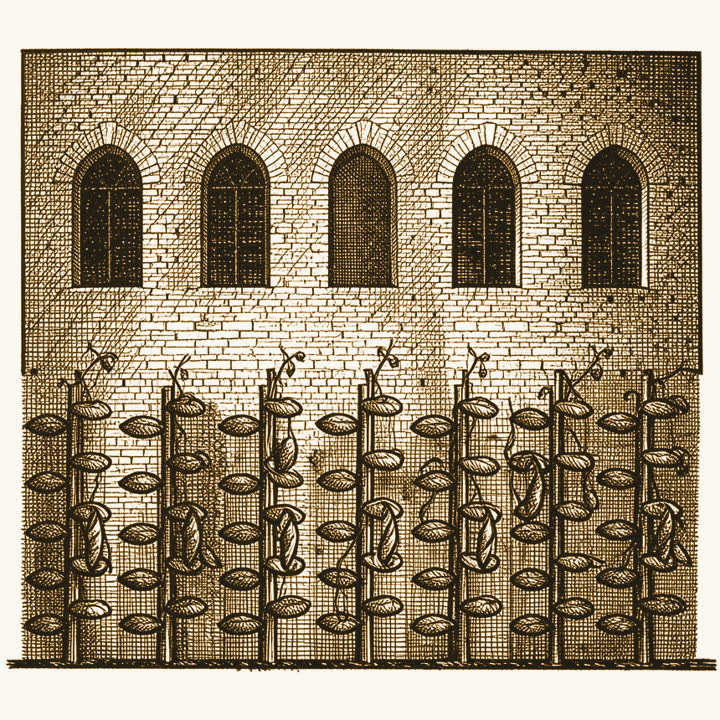
In a monastery garden, Gregor Mendel grew peas for eight years.
Mendel was a friar at the monastery of St Thomas in Brno, in what is now the Czech Republic. From 1856 to 1863 he grew and crossed pea plants in its garden. Over those years he worked with nearly thirty thousand plants. He wanted to know how features pass from parents to their offspring.
He chose seven features that came in two clear kinds.
Seeds were either round or wrinkled, and pods either green or yellow. Plants were either tall or short, and flowers either purple or white. Features with no in-between made the results easy to count. He also started with plants that bred true, always giving the same kind.
He crossed the plants by hand, carrying pollen from one to another.
Pea flowers normally fertilise themselves. Mendel moved pollen from one plant to another himself, so he chose each plant’s parents. That way he knew exactly which plants had been crossed. Then he planted the seeds, and waited to see what grew.
Crossing round seeds with wrinkled ones gave only round seeds.
The wrinkled kind seemed to vanish in the first generation of offspring. Mendel called the kind that showed dominant, and the kind that hid recessive. But had the wrinkled kind really gone? He let those plants fertilise themselves, and counted what came next.
In the next generation the wrinkled seeds came back, about one in four.
The hidden kind had been carried along unseen, and now it reappeared. The same happened with all seven features: roughly three of the dominant kind to one of the recessive. Mendel explained it with pairs of factors, one from each parent, that do not blend but stay separate. Today we call those factors genes.
He counted thousands of seeds, and the pattern was plain.
For seed shape alone, he counted five thousand four hundred and seventy four round seeds and one thousand eight hundred and fifty wrinkled ones. That is almost exactly three to one. In 1936 the statistician Ronald Fisher argued that some of the results fitted the expected ratios almost too well. That debate continues, but the three to one pattern has been confirmed in experiments many times since.
So when an idea is ignored, ask whether the world was ready for it.
Mendel presented his work in 1865 and published it in 1866. Few people took any notice. In 1868 he became abbot of the monastery, and his experiments slowed and stopped. In 1900, sixteen years after his death, three scientists independently rediscovered his results. In 2025, researchers finally identified the genes behind all seven of his pea features.
Sources
- Experiments in plant hybridization (1866), by Johann Gregor Mendel, Embryo Project Encyclopedia. What Mendel did, what he found, and how his paper was received.
- Genomic and genetic insights into Mendel’s pea genes, Nature, 2025. The study that pinned down the genes behind all seven of Mendel’s features.
- 1865: Mendel’s peas, National Human Genome Research Institute. A short account of Mendel’s crosses and the patterns he found.
Nearby ideas
- Nature does the selecting. How mockingbirds, finches and a letter from Wallace led to the theory of evolution.
- The fly with white eyes. How one white-eyed fly showed that genes sit on chromosomes.
- Genes are made of DNA. How dead bacteria, a purified extract and a kitchen blender showed genes are made of DNA.
- The shape that explained heredity. How an X-ray photograph and a chemical rule revealed the double helix of DNA.
- Reading the whole book of a human. How reading all three billion letters of human DNA changed what we know about ourselves.
- Scissors that find their own place. How a bacterial defence against viruses became a tool for editing genes.
- The pattern only you carry. How patterns of DNA bands reunited a family and solved a murder.