Cobra Effect · Genetics
Genes are made of DNA
How dead bacteria, a purified extract and a kitchen blender showed genes are made of DNA.
7 cards, read aloud in 3:21, with a test and sources.
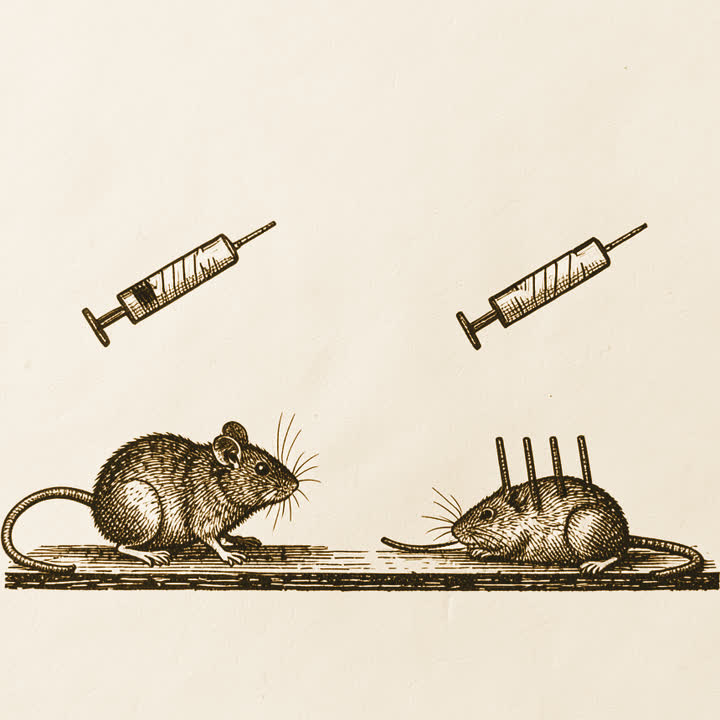
In 1928 Frederick Griffith was studying the bacteria that cause pneumonia.
One strain had a smooth coat and killed the mice it infected. Another strain, rough and without that coat, was harmless: the mice fought it off. Griffith, a medical officer in London, was working out how the two strains differed. What he found was far stranger.
Dead deadly bacteria, mixed with live harmless ones, killed a mouse.
Griffith killed the deadly smooth bacteria with heat. On their own, they did no harm. But when he injected them together with live, harmless rough bacteria, the mouse died. From its body he recovered live smooth bacteria. Something from the dead bacteria had changed the living ones. He called it the transforming principle.
In 1944 Oswald Avery and his colleagues tracked down what that substance was.
At the Rockefeller Institute in New York, Avery, Colin MacLeod and Maclyn McCarty purified the transforming principle. They removed sugars, fats and proteins, and it still worked. Enzymes that break down RNA did not stop it either. But even a trace of an enzyme that destroys DNA stopped it completely.
The transforming substance was DNA.
Purified DNA comes out of solution as pale, stringy threads that can be wound around a glass rod. Most scientists at the time expected genes to be made of protein, which seemed far more complicated. DNA looked too simple, built from just four kinds of building block. Many were not convinced by Avery’s result.
In 1952 Alfred Hershey and Martha Chase put it to another test, with viruses.
They used viruses that infect bacteria, made of little more than a protein coat with DNA inside. They marked the DNA with radioactive phosphorus, and the protein with radioactive sulfur. The viruses attach to bacteria and send something inside them. The question was which part went in: the protein or the DNA.
A kitchen blender shook off the empty coats, and the answer was DNA.
After the viruses had attached, Hershey and Chase whirled the mixture in a blender to strip off whatever stayed outside. Almost all the radioactive protein stayed outside the bacteria, in the empty coats. The radioactive DNA had gone inside. The result persuaded many who had doubted Avery that genes are made of DNA.
So when an answer seems too simple to be true, ask what the evidence says.
Protein looked like the obvious material for genes, and DNA looked too plain. Experiment after experiment pointed the other way. The next year, in 1953, the double helix showed how such a simple molecule could carry information. Four letters, in a long enough string, can spell out almost anything.
Sources
- Discovery of DNA as the hereditary material, Scitable, Nature Education. Griffith, Avery, and Hershey and Chase, and how the case for DNA was built.
- DNA as the stuff of genes, US National Library of Medicine. Avery’s work at the Rockefeller Institute, told through his papers and letters.
- The Hershey-Chase experiments (1952), Embryo Project Encyclopedia. The viruses, the radioactive labels and the blender.
Nearby ideas
- Peas that counted. How a friar counted thousands of peas and found the rules of inheritance.
- The fly with white eyes. How one white-eyed fly showed that genes sit on chromosomes.
- The shape that explained heredity. How an X-ray photograph and a chemical rule revealed the double helix of DNA.
- Reading the whole book of a human. How reading all three billion letters of human DNA changed what we know about ourselves.
- Scissors that find their own place. How a bacterial defence against viruses became a tool for editing genes.
- The pattern only you carry. How patterns of DNA bands reunited a family and solved a murder.