Cobra Effect · Genetics
The pattern only you carry
How patterns of DNA bands reunited a family and solved a murder.
7 cards, read aloud in 3:10, with a test and sources.
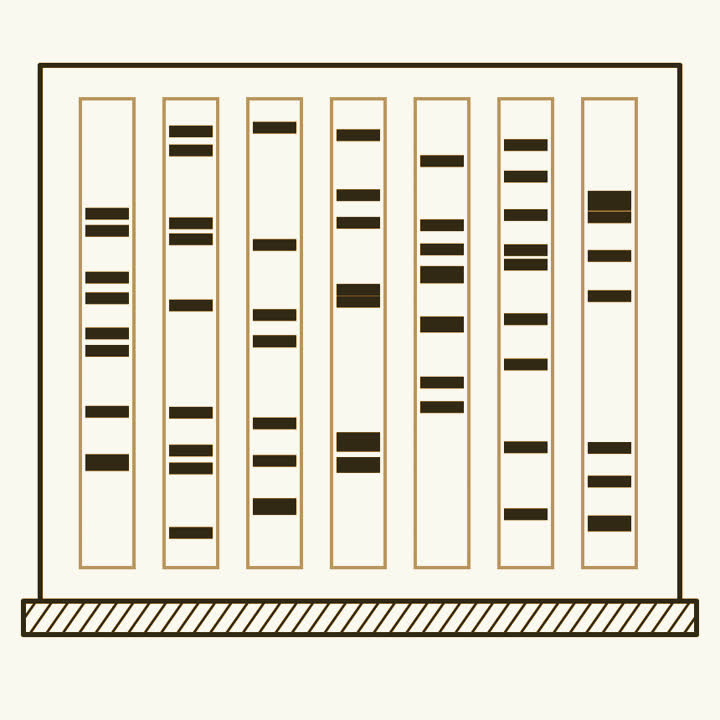
In September 1984, Alec Jeffreys looked at an X-ray film and saw something new.
Jeffreys, a geneticist at the University of Leicester, was studying stretches of DNA that repeat many times over. On the film, samples from different people showed patterns of dark bands. Each person’s pattern was different. He realised straight away that it could be used to tell people apart.
Apart from identical twins, no two people share the same pattern.
The repeating stretches vary in length from one person to another. Looked at together, they make a pattern as individual as a fingerprint. Jeffreys called it a DNA fingerprint. A sample of blood could be enough to read it.
Each band in a child’s pattern comes from the mother or the father.
A child inherits half of its DNA from each parent. So every band in the child’s pattern should match a band in one of the parents’ patterns. That made it possible to test whether people were related. Its first real use was not about a crime at all, but a family.
In 1985 a DNA fingerprint let a boy stay with his mother.
A boy named Andrew, born in Britain, had been living in Ghana, and was stopped on his return at Heathrow Airport. Officials doubted that he was really his mother’s son, and other tests could not settle it. A lawyer read about Jeffreys’ work and asked for help. His tests showed that Andrew belonged to the family. The decision against him was reversed, and Andrew stayed.
Soon the police asked whether DNA could help solve a crime.
Two teenage girls had been murdered in villages in Leicestershire, in 1983 and 1986. A local young man confessed to one of the killings, but Jeffreys’ tests showed he had committed neither. He became the first person cleared by DNA evidence. The police then asked thousands of local men to give blood samples.
In 1987 the killer was caught, after a colleague took the test in his place.
Colin Pitchfork had paid a workmate to give a sample for him, using a false passport. The workmate was later overheard talking about it, and the police were told. Pitchfork was arrested in September 1987, and his DNA matched. In January 1988 he became the first person convicted of murder using DNA profiling.
So when evidence seems certain, ask what it rules out as well as what it proves.
The first thing DNA did in that case was clear an innocent man who had confessed. Since then, DNA evidence has freed many people who were wrongly convicted. It has also convicted many who might otherwise have gone free. A pattern of bands, read carefully, can protect the innocent as well as catch the guilty.
Sources
- DNA fingerprinting, University of Leicester. Jeffreys’ discovery in 1984 and how it went on to change crime solving.
- Family fingerprints: the first case solved through genetic fingerprinting, Genetics Unzipped. How a DNA test settled the immigration case of a boy named Andrew.
- The dawn of DNA profiling, YourGenome. The moment the patterns appeared, and the Leicestershire case that followed.
Nearby ideas
- Genes are made of DNA. How dead bacteria, a purified extract and a kitchen blender showed genes are made of DNA.
- Reading the whole book of a human. How reading all three billion letters of human DNA changed what we know about ourselves.
- Peas that counted. How a friar counted thousands of peas and found the rules of inheritance.
- The fly with white eyes. How one white-eyed fly showed that genes sit on chromosomes.
- The shape that explained heredity. How an X-ray photograph and a chemical rule revealed the double helix of DNA.
- Scissors that find their own place. How a bacterial defence against viruses became a tool for editing genes.