Cobra Effect · Genetics
Reading the whole book of a human
How reading all three billion letters of human DNA changed what we know about ourselves.
7 cards, read aloud in 3:09, with a test and sources.
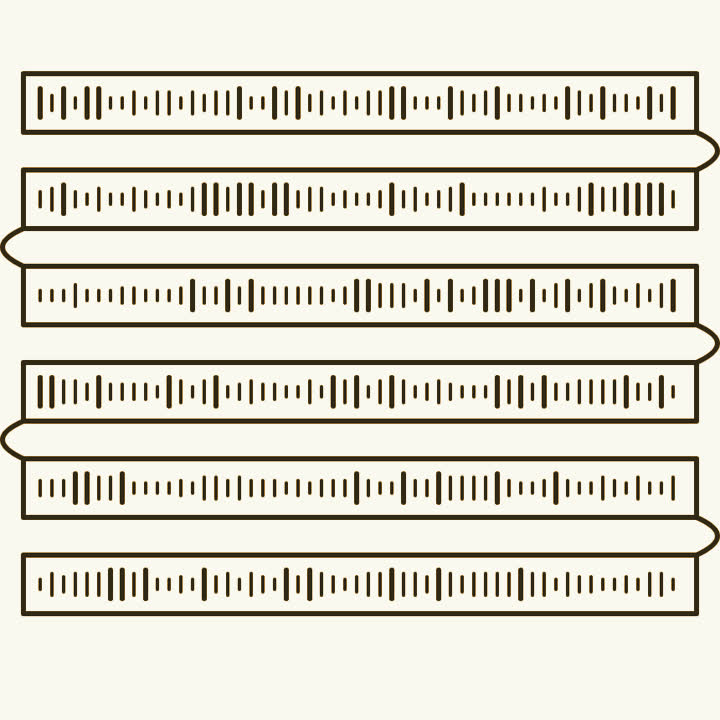
The human genome is written in about three billion letters of DNA.
Almost every cell in your body carries a copy, spread across its chromosomes. The letters are the four bases, A, T, G and C, in one very long string. Somewhere in that string are the instructions for building and running a person. In 1990, scientists set out to read all of it.
The Human Genome Project was a vast international effort.
Laboratories in several countries worked together, sharing what they found. Machines read short stretches of DNA, and computers pieced the stretches together. A private company raced to do the same, which pushed the pace. It was one of the largest projects biology had ever attempted.
In June 2000, a first draft was announced at the White House.
The draft covered about ninety per cent of the genome. President Bill Clinton and Francis Collins, who led the American side of the project, celebrated it. Gaps and errors remained, and the work went on. In April 2003 the project was declared complete, at a cost of about two point seven billion dollars.
Humans turned out to have far fewer genes than expected.
Before the project, many researchers expected somewhere between forty thousand and a hundred thousand genes. The finished sequence pointed to only twenty to twenty five thousand genes that make proteins. Today the count is settling at around twenty thousand. Much of what makes us complex seems to lie in how genes are switched on and off.
Even the finished genome had gaps, until 2022.
Some stretches of DNA repeat over and over, and were too hard for the methods of the time to read. In 2022 the Telomere to Telomere consortium published the first truly complete human sequence. It filled in the missing pieces, many of them long repeating stretches. Reading every letter had taken more than thirty years.
The cost of reading a genome has collapsed.
The first human genome cost billions of dollars and took more than a decade. Today a person’s genome can be read for less than a thousand dollars. Doctors use it to help find the causes of some rare diseases and to guide some cancer treatments. A project that once needed the world now fits in a single laboratory.
So when you notice how different people are, ask how much they share.
Any two people’s genomes are about ninety nine point nine per cent the same. The small differences, together with our lives and surroundings, help explain the variety between us. Reading the genome showed how much all humans have in common. The book is shared. Each copy just has a few differences of its own.
Sources
- Human Genome Project fact sheet, National Human Genome Research Institute. What the project set out to do, what it cost, and what it found.
- The complete sequence of a human genome, Science, 2022. The Telomere to Telomere consortium’s paper filling in the last gaps.
- The cost of sequencing a human genome, National Human Genome Research Institute. How the price of reading a genome fell from billions to under a thousand dollars.
Nearby ideas
- The shape that explained heredity. How an X-ray photograph and a chemical rule revealed the double helix of DNA.
- Genes are made of DNA. How dead bacteria, a purified extract and a kitchen blender showed genes are made of DNA.
- Scissors that find their own place. How a bacterial defence against viruses became a tool for editing genes.
- The pattern only you carry. How patterns of DNA bands reunited a family and solved a murder.
- Peas that counted. How a friar counted thousands of peas and found the rules of inheritance.
- The fly with white eyes. How one white-eyed fly showed that genes sit on chromosomes.