Cobra Effect · Learning and memory
Sleep and consolidation
Sleep is when the day’s learning gets filed away.
6 cards, read aloud in 2:11, with a test and sources.
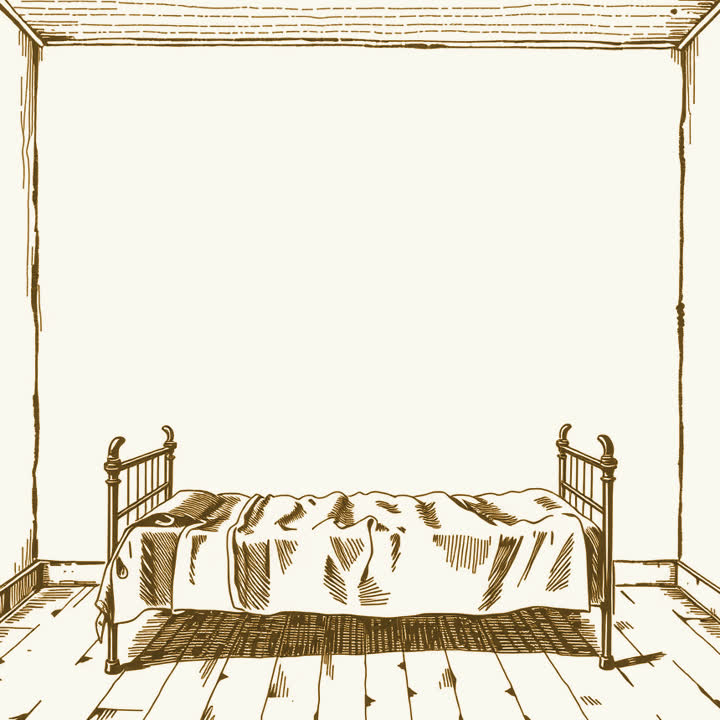
Two students agree to a strange experiment in 1924.
They learn lists of nonsense syllables, then either sleep or go about their day. At intervals they are woken, or called back, and asked to recall what they learned. John Jenkins and Karl Dallenbach want to know whether time alone does the forgetting.
Sleep won, and it was not close.
After 8 hours awake, most of the list was gone. After 8 hours asleep, more than half of it was still there. The clock had run the same either way. The waking hours were doing the damage.
Their explanation was that waking life gets in the way.
Every conversation and errand lays down new memories on top of the old ones. Later work found that sleep is doing more than merely leaving you alone. It is replaying the day and filing it.
In 1994 two researchers listened to sleeping rats.
Matthew Wilson and Bruce McNaughton recorded the cells a rat used while running a maze. During sleep, the same cells fired together again. The animal was running the maze once more, with its eyes shut. Sleep is not the pause between the learning. It is part of the learning.
Which makes the night before the exam an expensive trade.
Staying up buys hours of study and spends the filing that would have happened anyway. Matthew Walker and colleagues found in 2007 that a night without sleep left people far worse at taking in anything new the next day. So the loss runs in both directions. You are borrowing from the memory you are trying to build.
So treat sleep as the second half of studying.
Go over the hardest material last thing, then stop and go to bed. If the choice is an extra hour of revision or an extra hour of sleep, the sleep usually wins. The work you did today gets finished tonight, whether you help or not.
Sources
- Obliviscence during Sleep and Waking, John G. Jenkins and Karl M. Dallenbach, 1924. Two students, lists of nonsense syllables, and far less forgetting after sleep than after an ordinary day. Search the title for the paper. This page covers what followed.
- Memory: A Contribution to Experimental Psychology, Hermann Ebbinghaus, 1885. The book that began the measuring of forgetting, with the author as his own subject and thousands of nonsense syllables. This page tells the story.
- Sleep and memory, Wikipedia. What is known about the stages of sleep, which kinds of memory each one seems to serve, and how much of it is still argued over.
Nearby ideas
- The spacing effect. Spread your study out over time and it lasts far longer.
- The testing effect. Pulling an answer from memory teaches more than reading it again.
- Desirable difficulties. The practice that feels hardest is often the practice that sticks.
- Interleaving. Mixing problem types feels worse and teaches better.
- The Feynman technique. If you cannot explain it simply, you have found a gap.
- Chunking. Experts see patterns where beginners see pieces.
- Deliberate practice. Hours alone do not build skill. Focused work on weaknesses does.
- The method of loci. Pin what you need to remember to a place you already know.