Cobra Effect · Learning and memory
Chunking
Experts see patterns where beginners see pieces.
7 cards, read aloud in 3:16, with a test and sources.
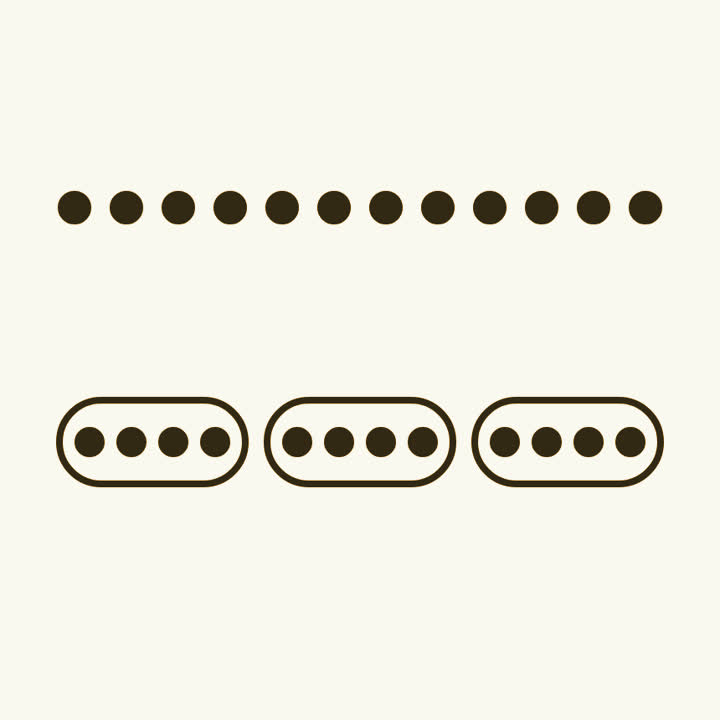
Read this once, then look away. 1 4 9 2 1 7 7 6 2 0 0 1.
Twelve digits. Most people manage about seven before the rest slide off. Now try 1492, 1776, 2001. The same twelve digits. Three dates. Three things to remember instead of twelve.
George Miller measured the shelf in 1956.
His paper is called The Magical Number Seven, Plus or Minus Two. Short term memory holds about seven items. Not seven digits, or seven words, but seven of whatever unit you are using. Miller called the unit a chunk. The trick is not to hold more chunks. It is to put more into each one.
Miller’s colleague showed how far it goes.
A man named Sidney Smith taught himself to hear strings of ones and zeros as groups. Three binary digits became one number from zero to seven. With practice he could repeat back about 40 binary digits after a single hearing. His memory had not grown. His chunks had.
Then the chess players.
In 1973 William Chase and Herbert Simon showed chess positions to a master, a club player and a beginner, for five seconds each. From a real game, the master put back about 16 pieces. The beginner managed about 4. Then they scattered the pieces at random. The master fell to the beginner’s level. He had never been remembering pieces. He had been remembering chess.
That is chunking.
An expert doesn’t see more. An expert sees fewer, bigger things. A beginner sees 25 pieces. A master sees a handful of familiar shapes, each one carrying a dozen pieces inside it. Simon estimated a master carries about 50,000 such shapes in memory. Every one of them was once a pile of pieces. The seven, by the way, is contested. Later work puts the shelf nearer four. The chunk is not.
It runs your whole reading life.
You are not reading letters. You stopped in primary school. A phone number is printed in groups because ten digits won’t stay and three groups will. A doctor sees a syndrome where you see a list of symptoms. Learning a field is mostly the slow business of turning its pieces into shapes.
So when something won’t stay in your head, don’t push harder. Group it.
Find the pattern that turns twelve things into three. Give the group a name, so it takes one slot instead of many. And when you are learning something hard, remember the chess master. Every position he saw in a flash was once a board of scattered pieces. The chunks come from the hours. There is no other source.
Sources
- The Magical Number Seven, Plus or Minus Two, George Miller, 1956. The paper that introduced the chunk, with Sidney Smith and his binary digits. This page summarises it and links to the full text, which is short and readable.
- Moonwalking with Einstein, Joshua Foer, 2011. A journalist trains for the memory championships and finds that every trick the champions use is chunking in disguise. The chess research is in it.
- Chunking (psychology), Wikipedia. The idea, Chase and Simon’s chess study, the later estimate of about four chunks rather than seven, and how memory champions stretch the limit.
Nearby ideas
- The spacing effect. Spread your study out over time and it lasts far longer.
- Interleaving. Mixing problem types feels worse and teaches better.
- The curse of knowledge. Once you know something, you cannot see what a beginner is missing.
- Deliberate practice. Hours alone do not build skill. Focused work on weaknesses does.
- The method of loci. Pin what you need to remember to a place you already know.
- The Zeigarnik effect. Unfinished tasks stay on your mind until they are closed.
- Dual coding. Words and pictures together stick better than either alone.
- Cognitive load. The mind can juggle only a few new things at once.