Cobra Effect · Learning and memory
The method of loci
Pin what you need to remember to a place you already know.
6 cards, read aloud in 2:36, with a test and sources.
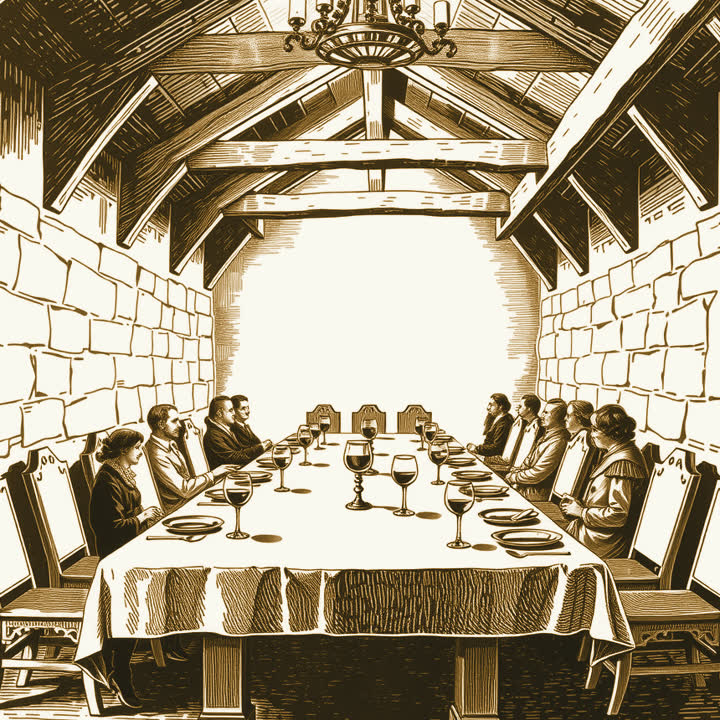
Thessaly, a banquet, and a roof about to fall.
The poet Simonides of Ceos recites a poem in honour of his host, a nobleman called Scopas. The host, so the story goes, pays him half, and says the twin gods praised in the poem can pay the rest. A servant tells Simonides two young men are waiting outside for him. He steps out. There is no one there.
Behind him, the hall collapses.
Everyone inside is crushed. The bodies are too broken for the families to recognise. Simonides walks the ruin in his mind and points. This one sat there. That one sat there. He can name every guest, because he remembers where each of them sat.
Cicero told that story in 55 BC, and called it the birth of the art of memory.
Simonides lived 400 years before Cicero, so the tale is almost certainly a legend. But the method it teaches is real, and the Romans wrote it down carefully. Pick a place you know well. Walk through it in your mind. Put each thing you must remember somewhere along the route. Loci is Latin for places. That is the method of loci.
Why places stick when lists don’t.
You have been remembering places for as long as your ancestors have needed to find water and avoid the cliff. Your brain is very good at it and never gets tired of it. It is bad at lists, because nobody ever died from forgetting item seven. The method borrows the strong memory to carry the weak one.
The memory champions still use it.
In 2003, Eleanor Maguire’s team scanned the brains of leading memory competitors. They were not unusually clever, and their brains were not unusual either. Nearly all of them used the method, and while memorising, the parts of the brain for navigating space lit up. Two thousand year old software running on standard hardware.
Build one tonight.
Take your ten item shopping list and your own front door. Put the eggs on the doormat, cracked. Hang the bread from the coat hook. Let the milk flood the hallway. Make each image absurd. Absurd sticks. Then walk through the house in your head at the shop. You will not forget the milk.
Sources
- Method of loci, Wikipedia. The technique, the Simonides story as told by Cicero and Quintilian, the Roman handbook that laid out the rules, and the competitors who still use it.
- The Art of Memory, Frances Yates, 1966. The history of the memory palace from Simonides to the Renaissance, when scholars built imaginary theatres to hold everything they knew. Dense and strange and worth it.
- Moonwalking with Einstein, Joshua Foer, 2011. A journalist trains for a year with the method and wins the American memory championship. The best modern account of what it feels like to build a palace.
Nearby ideas
- Chunking. Experts see patterns where beginners see pieces.
- The spacing effect. Spread your study out over time and it lasts far longer.
- The testing effect. Pulling an answer from memory teaches more than reading it again.
- The Zeigarnik effect. Unfinished tasks stay on your mind until they are closed.
- Dual coding. Words and pictures together stick better than either alone.
- Cognitive load. The mind can juggle only a few new things at once.
- The illusion of competence. Feeling familiar with material is not the same as knowing it.
- The generation effect. Trying to produce an answer first makes it stick, even when you are wrong.