Cobra Effect · Everyday machines
How a fridge moves heat out of a box
How a fridge carries heat out of a box, using a liquid that boils and condenses.
7 cards, read aloud in 2:49, with a test and sources.
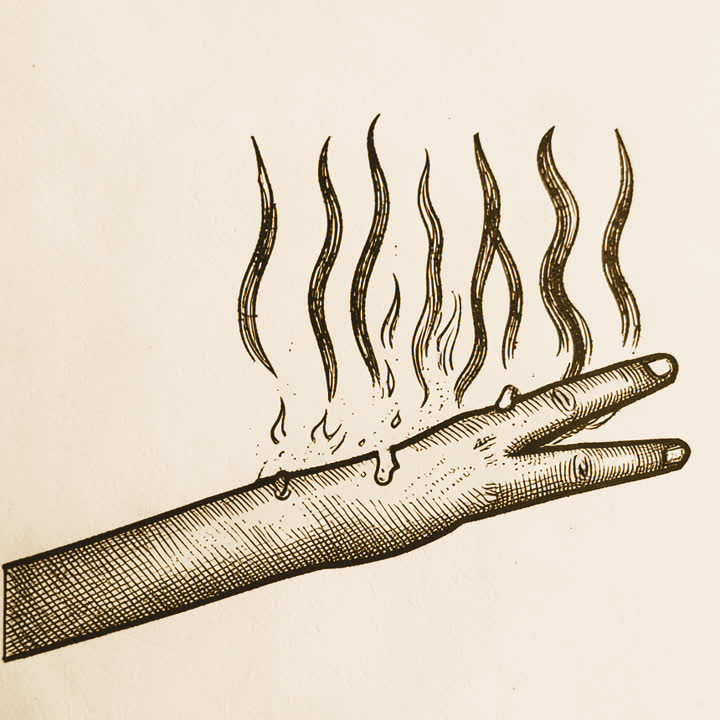
A fridge does not make cold. It carries heat out of the box and into the kitchen.
Heat flows naturally from warm things to cold ones, so moving it the other way takes work. The trick every fridge relies on is that a liquid soaks up heat as it evaporates. It is the same reason wet skin feels cool as it dries.
In the mid 1700s, William Cullen made a little ice by making ether evaporate.
He lowered the pressure with a pump, so the ether boiled away quickly, drawing heat from its surroundings. It was a demonstration, not a practical machine. A machine that could use the same liquid over and over came roughly eighty years later.
In 1834, Jacob Perkins patented a machine that used the same liquid again and again.
A pump squeezed the vapour, it cooled and turned back to liquid, and then it was allowed to boil again. A working prototype was built, but it was not a commercial success. His patent described the cycle that nearly every fridge still uses.
The cycle has four steps that repeat endlessly.
A compressor squeezes the refrigerant vapour, making it hot. Coils at the back let that heat escape into the room, and the vapour turns to liquid. The liquid passes through a narrow valve, where its pressure drops and it becomes very cold. Inside the cabinet it boils, soaking up heat from the food, and flows back to the compressor.
Refrigeration first earned its keep in breweries and meat works.
In the 1850s, James Harrison built ice making machines in Australia. In the 1870s, Carl von Linde built reliable refrigeration machines, many of them for breweries. Electric fridges for homes appeared in the 1910s and 1920s.
Early home fridges used gases that could poison or burn.
After deadly leaks in the late 1920s, a team including Thomas Midgley developed a safer refrigerant. That chemical was later found to damage the ozone layer, and it was phased out under a 1987 treaty. Fridges today use other refrigerants, but the same cycle.
So when a machine seems to create cold, ask where the heat went.
Feel the back of a fridge, and it is warm. That warmth is the heat taken from the food, plus the energy the compressor used. Leaving the door open does not cool the kitchen. It warms it slightly.
Sources
- How do refrigerators work?, Explain that Stuff. A plain, illustrated explanation of the heat conveyor belt.
- Vapor compression refrigeration, Wikipedia. The four step cycle, and its history from Evans and Perkins onward.
- Refrigeration, Encyclopaedia Britannica. From Cullen’s demonstration to modern refrigerants.
Nearby ideas
- Moving heat is cheaper than making it. Why a heat pump delivers more heat than the electricity it uses.
- The ozone hole and the treaty that worked. How a warning about spray-can chemicals led to a treaty every country signed.
- How messages cross the internet in pieces. How messages cross networks as small pieces that each find their own way.
- How the barcode got from the beach to the checkout. How a pattern drawn in beach sand became the code on almost everything you buy.
- How a battery learned to carry lithium safely. How three scientists made a rechargeable battery that carries lithium safely.
- How a jet engine pushes a plane forward. How a jet engine drives a plane forward by throwing gas backward.
- How a touchscreen knows where you touched. How touchscreens sense your finger, and the decades of work behind them.
- The microwave oven and the melted snack bar. What the records show about how the microwave oven was invented, and how it heats.