Cobra Effect · Relativity
Gravity slows time
Why clocks run slower in stronger gravity, and why GPS has to allow for it.
7 cards, read aloud in 3:28, with a test and sources.
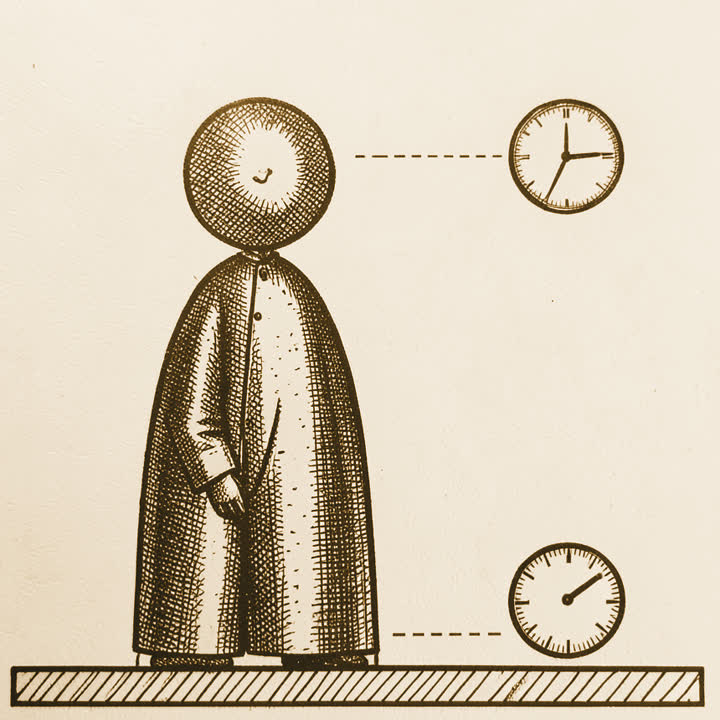
Your head is ageing slightly faster than your feet.
Clocks run slower the deeper they sit in gravity. Between your head and your feet the difference is tiny, about half a millionth of a second over eighty years. Albert Einstein predicted it in 1907, from his thinking about rockets and falling. For more than fifty years nobody could measure it.
In 1959 two physicists sent gamma rays up and down a tower at Harvard.
Robert Pound and Glen Rebka fired them between the top and bottom of a tower 22.5 metres tall. Light climbing out of gravity loses a little energy, so its frequency drops. They measured a shift of about two and a half parts in a million billion. It matched Einstein’s prediction to within about ten per cent.
In 1976 a rocket carried an atomic clock ten thousand kilometres up.
The experiment was called Gravity Probe A, and the flight lasted under two hours. As the rocket climbed away from the Earth, its clock ran faster than clocks on the ground. Once its speed was allowed for, the gain matched Einstein to about seventy parts in a million. Higher up, time really does pass more quickly.
Every GPS satellite has to allow for it.
GPS satellites orbit about 20,000 kilometres up, each carrying atomic clocks. The weaker gravity up there makes their clocks gain about 45 millionths of a second a day. Their speed makes them lose about 7. Left uncorrected, the clocks would gain 38 millionths of a second a day, and light travels about eleven kilometres in that time. So the clocks are set to tick slightly slower before they are launched.
The best clocks can now tell when one is lifted by a third of a metre.
In 2010 physicists at the US National Institute of Standards and Technology compared two clocks, each built around a single aluminium atom. Raising one clock by just 33 centimetres made it run measurably faster. The difference was about four parts in a hundred million billion. Time runs faster on the top stair than on the bottom one.
In 2022 physicists measured the difference across a single millimetre.
At JILA in Colorado, they held about a hundred thousand strontium atoms in a column about a millimetre tall. Atoms at the top ticked faster than atoms at the bottom, by about one part in ten billion billion. Nobody had measured gravity slowing time over so small a height before. Clocks this good could one day map the rock and water beneath our feet by how they tick.
So when you check the time, ask how high up your clock is.
Time is not the same everywhere. It runs fastest far from mass and slowest deep within it. On the Earth the differences are tiny, but GPS could not work without allowing for them. Near something far denser than the Earth, the slowing becomes enormous. At the edge of a black hole, seen from far away, time seems to stop.
Sources
- Gravitational time dilation, Wikipedia. What gravity does to clocks, the experiments that measured it, and how big the effect is for the Earth, the Sun and beyond.
- Pound–Rebka experiment, Wikipedia. How two physicists measured light losing energy as it climbed a tower at Harvard, and why it took such care.
- Error analysis for the Global Positioning System, Wikipedia. Its section on relativity explains the 38 millionths of a second a day and how the satellite clocks are set before launch.
Nearby ideas
- Moving clocks run slow. Why moving clocks run slow, and how muons and airliners proved it.
- Gravity bends light. Why starlight bends around the Sun, and how a 1919 eclipse proved it.
- Space itself can ripple. Why colliding black holes shake space, and how LIGO finally felt it.
- Where not even light escapes. Why some stars collapse into places light cannot leave, and how we found them.
- The constant speed of light. Why light is measured at the same speed by everyone, however they move.
- Mass and energy are the same thing. Why mass and energy are the same thing, and why a gram holds so much.
- Falling feels like floating. Why falling feels like floating, and how that led Einstein to gravity.