Cobra Effect · Relativity
Moving clocks run slow
Why moving clocks run slow, and how muons and airliners proved it.
7 cards, read aloud in 3:24, with a test and sources.
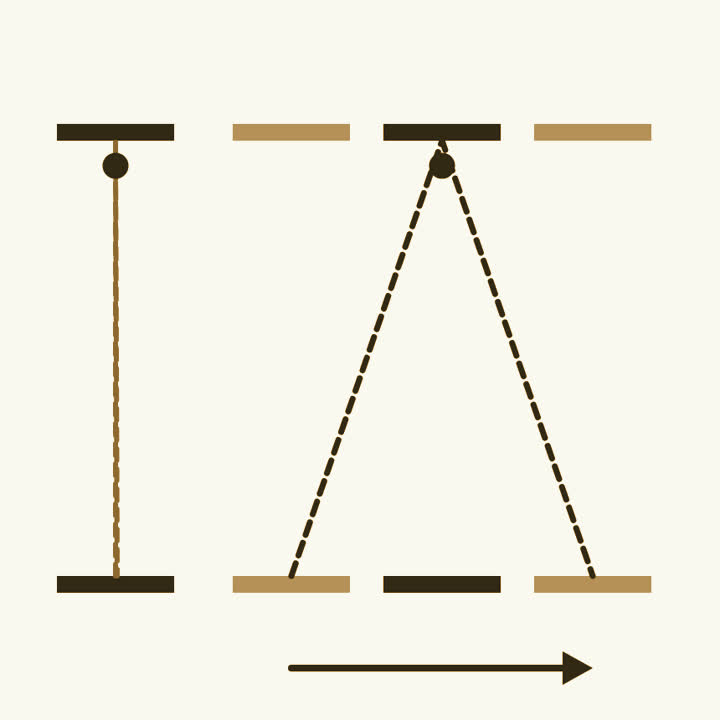
Build a clock out of light, bouncing between two mirrors.
Each time the light reaches the top mirror and returns, the clock ticks once. Now put the clock on a fast spaceship and watch it fly past. From outside, the light has to travel on a slant to keep up with the moving mirrors. A slanted path is longer, and light cannot go any faster to make up for it.
So the moving clock ticks more slowly. Every moving clock does.
It is not a quirk of clocks made of light. If only light clocks slowed, a traveller could compare clocks and tell they were moving, and steady motion cannot be detected. So every clock on the ship slows by the same amount, atoms and heartbeats included. At everyday speeds the slowing is tiny. Near the speed of light, it grows without limit.
Particles from space prove it every second.
Cosmic rays striking the top of the atmosphere make short lived particles called muons. A muon sitting still lasts only about two millionths of a second on average. Even at nearly the speed of light, that should carry most of them well under a kilometre. Yet they rain down on the ground from about 15 kilometres up.
In 1963 two physicists counted them on a mountain and at sea level.
David Frisch and James Smith counted muons near the top of Mount Washington, then again near sea level. Without slowed time, only a tiny share should have survived the drop. Far more arrived, just as many as slowed clocks predict. Seen from the ground, the muons’ own clocks were running about nine times slower.
In 1971 two scientists flew atomic clocks around the world.
Joseph Hafele and Richard Keating took four atomic clocks on ordinary passenger flights, once eastward and once westward. When they landed, the clocks no longer agreed with the clocks left behind. The differences were tens to hundreds of billionths of a second, and they matched what relativity predicted. Part of the effect came from speed, and part from flying high above the ground, where gravity is weaker.
Particle accelerators see it as a matter of routine.
In 1977, at CERN, muons were sent racing around a storage ring at nearly the speed of light. They lasted about 29 times longer than muons sitting still. That was exactly the slowing their speed predicted. For the people who design accelerators, slowed time is ordinary engineering.
So when you hear that time is the same everywhere, ask whose clock is moving.
Time is not one clock ticking for the whole universe. Each clock keeps its own time, and a moving one runs slow when seen from outside. Astronauts on the space station age slightly slower than people on the ground, by less than a hundredth of a second over six months. Tiny for us. Yet the satellites that tell your phone where it is have to correct for it.
Sources
- The Special Theory of Relativity, Richard Feynman, The Feynman Lectures on Physics, Volume I, 1963. Chapter fifteen builds the light clock, shows why every clock must slow with it, and uses muons from cosmic rays as the proof.
- Hafele–Keating experiment, Wikipedia. The 1971 flights of atomic clocks around the world, eastward and westward, and how the results matched the predictions of relativity.
- Time dilation, Wikipedia. Why moving clocks run slow, the muon measurements from cosmic rays and accelerators, and the corrections navigation satellites make.
Nearby ideas
- The constant speed of light. Why light is measured at the same speed by everyone, however they move.
- Mass and energy are the same thing. Why mass and energy are the same thing, and why a gram holds so much.
- Falling feels like floating. Why falling feels like floating, and how that led Einstein to gravity.
- Gravity bends light. Why starlight bends around the Sun, and how a 1919 eclipse proved it.
- Gravity slows time. Why clocks run slower in stronger gravity, and why GPS has to allow for it.
- Space itself can ripple. Why colliding black holes shake space, and how LIGO finally felt it.
- Where not even light escapes. Why some stars collapse into places light cannot leave, and how we found them.