Cobra Effect · Learning and memory
Interleaving
Mixing problem types feels worse and teaches better.
6 cards, read aloud in 2:32, with a test and sources.
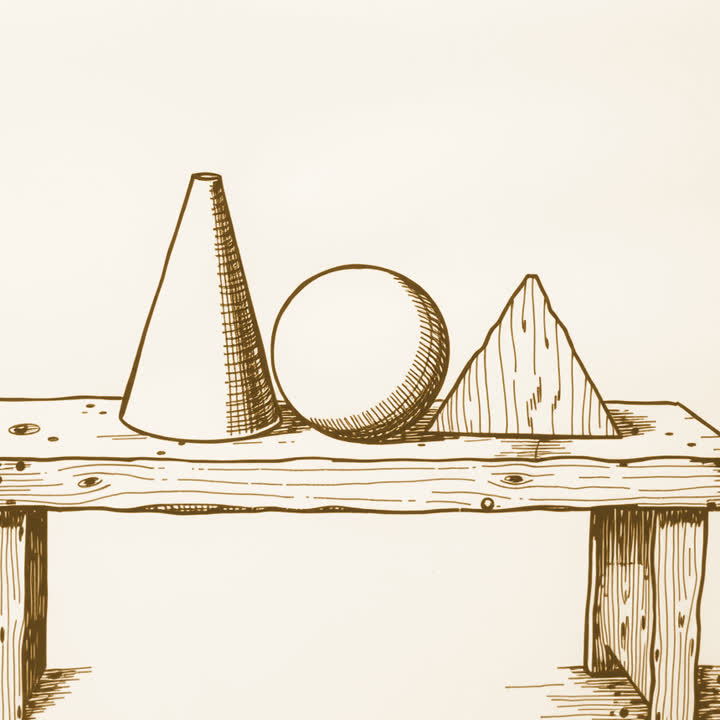
Two groups learn to find the volume of four solids. Same problems, different order.
Doug Rohrer and Kelli Taylor, 2007. One group works through the problems in blocks. All the wedges, then all the spheroids, and so on. The other group gets the same problems shuffled together. During practice, the blocked group does better.
A week later, the test. The blocked group scores 20%. The shuffled group scores 63%.
Same students, same problems, same amount of practice. The only difference was the order. And the group that had felt slower and more confused during practice remembered three times as much.
That is interleaving.
Mixing different kinds of problem in one session, instead of drilling one kind at a time. In a blocked session you never have to decide which method to use. The chapter heading tells you. In a mixed session every problem starts with a question. What kind of thing is this? That is the question the exam asks. Blocked practice never lets you rehearse it.
It works on painters as well as prisms.
Nate Kornell and Robert Bjork, 2008. Students learned to recognise the styles of twelve painters, either one painter at a time or all mixed up. Mixed won clearly. Then the students were asked which method had worked better for them. Most said blocked. They had just been shown it hadn’t.
Why it feels wrong and works anyway.
Blocked practice feels smooth because you are repeating the last move. Smooth is not the same as learned. The effort of switching, of retrieving the right method from among the wrong ones, is what makes it stick. The confusion during practice was the learning happening.
So shuffle your practice.
Do not do twenty of the same problem. Do five, then five of something else, then come back. Mix old topics into new sessions. When you study a set of anything, languages, chords, case law, jumble the order so you must first identify what you are looking at. It will feel worse. Check the score in a week.
Sources
- The shuffling of mathematics problems improves learning, Doug Rohrer and Kelli Taylor, 2007. Instructional Science, volume 35. The four solids, the shuffled problems, and the 63 to 20 result a week later. Search the title for a copy.
- Make It Stick, Peter Brown, Henry Roediger and Mark McDaniel, 2014. The science of learning for people who have to do it. Chapter 3 covers mixing up practice, with the painters and the prisms.
- Learning concepts and categories: Is spacing the enemy of induction?, Nate Kornell and Robert Bjork, 2008. Psychological Science. The painters study, including the students who insisted the method that worked had not.
Nearby ideas
- The spacing effect. Spread your study out over time and it lasts far longer.
- Desirable difficulties. The practice that feels hardest is often the practice that sticks.
- The testing effect. Pulling an answer from memory teaches more than reading it again.
- The Feynman technique. If you cannot explain it simply, you have found a gap.
- Chunking. Experts see patterns where beginners see pieces.
- Deliberate practice. Hours alone do not build skill. Focused work on weaknesses does.
- The method of loci. Pin what you need to remember to a place you already know.
- The Zeigarnik effect. Unfinished tasks stay on your mind until they are closed.