Cobra Effect · Learning and memory
The testing effect
Pulling an answer from memory teaches more than reading it again.
6 cards, read aloud in 2:24, with a test and sources.
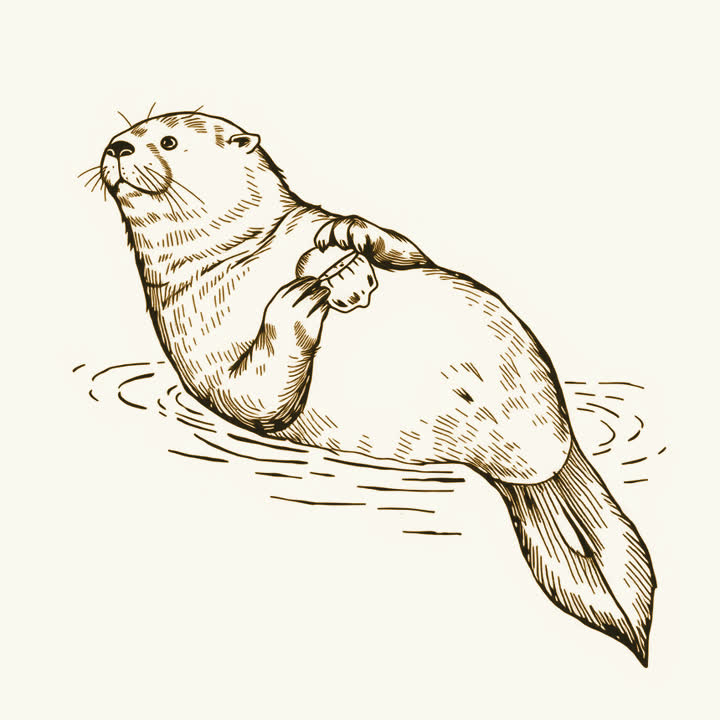
Two groups of students read the same passage about sea otters.
Washington University in St Louis, 2006. Henry Roediger and Jeffrey Karpicke give one group the passage to read a second time. The other group gets a blank sheet and has to write down everything they remember. Then everyone goes home.
Five minutes later, the rereaders are ahead. A week later, they have collapsed.
Tested straight away, the group that reread remembered a little more. Tested after a week, they remembered about 40% of the passage. The group that had written from memory remembered about 56%. One attempt at recalling had done more than a second reading.
That is the testing effect.
Pulling a memory out strengthens it more than putting it in again. The test isn’t measuring the learning. The test is the learning. Psychologists had seen it as early as 1909, and forgotten it. Roediger and Karpicke made it impossible to ignore.
The students had no idea.
Asked which group would remember more in a week, they picked the rereaders. Rereading feels smooth. The words look familiar, and familiar feels like known. Writing from memory feels like failing, right up to the moment it works. The method that felt best worked worst.
In 2011 they went further, and beat the best study method there was.
Karpicke and Janell Blunt had students learn a science text. Some drew concept maps, the method teachers praised most. Others simply closed the text and wrote what they recalled, twice. A week later the recallers won, even on questions that required linking ideas together. The mappers, again, had predicted the opposite.
So stop rereading. Start retrieving.
Close the book and write what you know. Then open it and see what you missed. Turn headings into questions and answer them cold. Quiz a friend and let them quiz you. It will feel worse than reading. That is how you know it’s working.
Sources
- Testing effect, Wikipedia. The 2006 paper, the century of earlier findings, the 2011 concept map study, and the conditions under which the effect is strongest.
- Make It Stick, Peter Brown, Henry Roediger and Mark McDaniel, 2014. Roediger explaining his own research for a general reader. Retrieval is the first chapter and the spine of the book.
- Retrieval Practice, Pooja Agarwal. A researcher’s site for teachers. Free guides on how to build retrieval into lessons, with the studies behind each one.
Nearby ideas
- Desirable difficulties. The practice that feels hardest is often the practice that sticks.
- The spacing effect. Spread your study out over time and it lasts far longer.
- The Dunning Kruger effect. Why the least skilled are often the worst judges of their skill.
- Interleaving. Mixing problem types feels worse and teaches better.
- The Feynman technique. If you cannot explain it simply, you have found a gap.
- Chunking. Experts see patterns where beginners see pieces.
- Deliberate practice. Hours alone do not build skill. Focused work on weaknesses does.
- The method of loci. Pin what you need to remember to a place you already know.