Cobra Effect · People and organisations
Little’s law
How long things wait depends on how many are already waiting.
6 cards, read aloud in 2:28, with a test and sources.
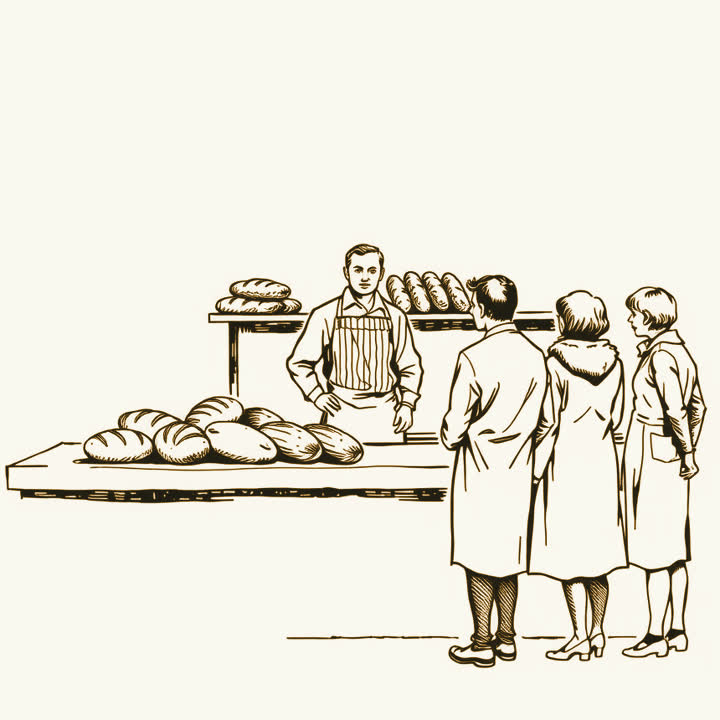
A bakery, Saturday morning. The queue never seems to shrink.
The baker counts. About twenty people come in every hour. Each one spends about fifteen minutes inside, queuing, choosing, paying. So how many people are in the shop at any moment? You don’t need to look. You can work it out.
Five. Twenty an hour, a quarter of an hour each.
Arrivals per hour, times the hours each one stays, equals the people inside. John Little proved in 1961 that this holds for any steady queue at all. It does not matter how the arrivals bunch, how long each takes, or who is served first. Three numbers, and if you know two, you know the third.
That is Little’s law. Now turn it around.
A team finishes ten tasks a week and has forty tasks in progress. Forty divided by ten. Each task takes four weeks, on average, from start to finish. Not because anyone is slow. Because forty things are sharing the team’s attention, and every one of them waits its turn.
The way to finish faster is to start less.
Cap the work in progress at twenty. Same team, same ten a week. Now each task takes two weeks. Nothing got quicker. Nobody was added. There is simply less waiting in the pile. This is why factory floors and software teams put a hard limit on how much is open at once.
Every long wait has this arithmetic behind it.
The hospital bed that is never free. The email that sits in an inbox for a week. The document in a review queue of thirty. When people say they are busy, they usually mean the pile is deep, not that the flow is fast. Deep piles make slow deliveries. Always.
Count the three numbers.
How many things are in progress? How many finish each week? Divide, and that is how long the next one will take, whatever anyone promises. If you want that number smaller, close things before you open things. Finishing is a rate. Starting is a choice.
Sources
- Little’s law, Wikipedia. The formula, John Little’s 1961 proof in the journal Operations Research, the assumptions, and worked examples with shops and queues.
- The Goal, Eliyahu Goldratt, 1984. A novel about a factory manager drowning in work in progress, and what happens when he stops starting things. The arithmetic in this story runs underneath the whole plot.
- Kanban (development), Wikipedia. The software method built on limiting work in progress. Cards on a board, a cap per column, and pull rather than push.
Nearby ideas
- Brooks’s law. Adding people to a late project makes it later.
- Parkinson’s law. Work expands to fill the time you give it.
- Conway’s law. Systems end up shaped like the teams that build them.
- The Ringelmann effect. The bigger the group, the less effort each person puts in.
- Milgram’s obedience experiments. Ordinary people follow harmful orders when the setting pushes them.
- Pluralistic ignorance. Everyone can privately doubt a rule that nobody questions out loud.
- Gall’s law. Complex systems that work grow out of simple ones that worked.
- Cunningham’s law. The fastest way to get the right answer is to post a wrong one.