Cobra Effect · People and organisations
Milgram’s obedience experiments
Ordinary people follow harmful orders when the setting pushes them.
7 cards, read aloud in 3:11, with a test and sources.
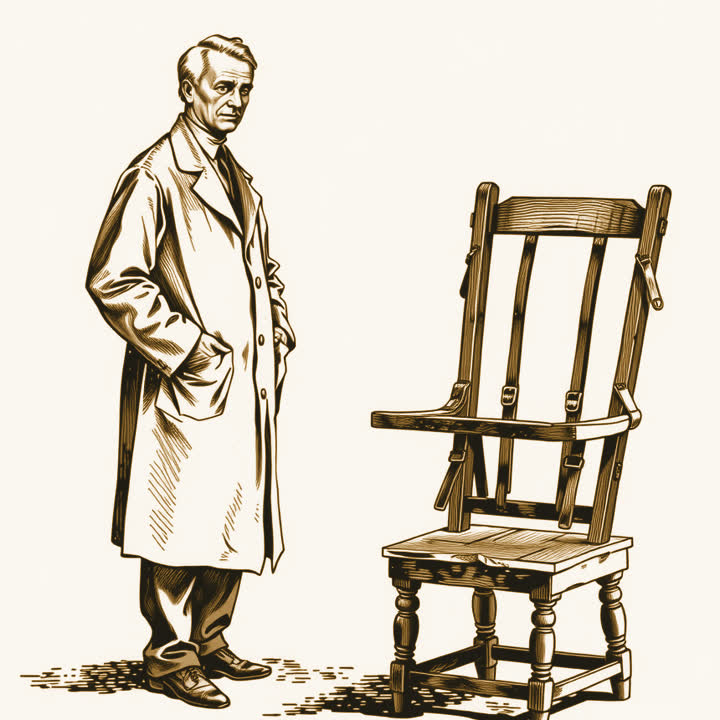
New Haven, 1961. A newspaper advert offers a few dollars for an hour on memory.
You arrive at a Yale laboratory and meet a man in a grey coat and another volunteer, a mild accountant. Lots are drawn. You are the teacher. He is the learner. He is strapped into a chair in the next room with an electrode on his wrist. Your job is to shock him every time he gets a word pair wrong.
The machine has thirty switches. Each one is stronger than the last.
The learner gets answers wrong. You shock him. At 150 volts he shouts that he wants out. At 300 he pounds on the wall. After that, silence. You turn to the man in the coat. He says, please continue. The experiment requires that you continue.
Before he began, Milgram asked psychiatrists to predict how far people would go.
They guessed that only a tiny fraction, about one in a thousand, would go to the end. In the baseline version, 26 of the 40 volunteers went all the way to 450 volts. Sixty five percent. The learner was an actor. The shocks were fake. The sweating and the trembling were not.
Stanley Milgram published in 1963, and the world read it as a verdict on human nature.
Ordinary people, told to by someone in a coat, will hurt a stranger. That is the famous reading. It is also too simple, and Milgram’s own data says so.
The variations mattered more than the headline.
Put the learner in the same room and obedience fell to 40%. Make the teacher press the learner’s hand onto the plate, 30%. Have the man in the coat give orders by telephone, about 20%. Add two other teachers who refused, and only 10% went on. People didn’t simply obey authority. They obeyed it when it was close, the victim was far, and nobody else was saying no.
The archives tell a rougher story.
In 2012 the psychologist Gina Perry went through Milgram’s tapes and papers. The man in the coat often went off script, pushing far beyond the four set prompts. Many volunteers said afterwards they had doubted the shocks were real. And the debriefing was patchy. Some went home believing they had hurt a man. The 65% is real. What it means is still argued.
What to take from it.
The lever that moved people was not a shout. It was a calm voice saying the experiment requires it. So notice the coat. Whenever someone’s authority is doing your thinking, ask what you would do if they weren’t in the room. And remember the 10%. One other person refusing was the strongest thing in the building. Be that person, or find them.
Sources
- Milgram experiment, Wikipedia. The setup, the numbers, every variation, and the ethical row. Search Behavioral Study of Obedience 1963 for Milgram’s first paper in the Journal of Abnormal and Social Psychology.
- Obedience to Authority, Stanley Milgram, 1974. Milgram’s own account of all the variations, with transcripts of volunteers arguing with the man in the coat. Short and unsettling.
- Behind the Shock Machine, Gina Perry, 2012. What the Yale archives and the surviving volunteers say about how the experiments were really run. The book that made the 65% harder to quote without a footnote.
Nearby ideas
- Asch’s conformity experiments. Why people go along with a group they can see is wrong.
- The bystander effect. The more people who see a problem, the less each one acts.
- The fundamental attribution error. We blame people’s character and overlook their situation.
- Pluralistic ignorance. Everyone can privately doubt a rule that nobody questions out loud.
- Gall’s law. Complex systems that work grow out of simple ones that worked.
- Cunningham’s law. The fastest way to get the right answer is to post a wrong one.
- Pournelle’s iron law of bureaucracy. In any organisation, those who serve the organisation end up in charge.
- The bus factor. How many people could leave before the work stops.