Cobra Effect · Big open questions
Why is there more matter than antimatter?
Why the universe is made of matter, when the Big Bang should have made equal antimatter.
7 cards, read aloud in 2:44, with a test and sources.
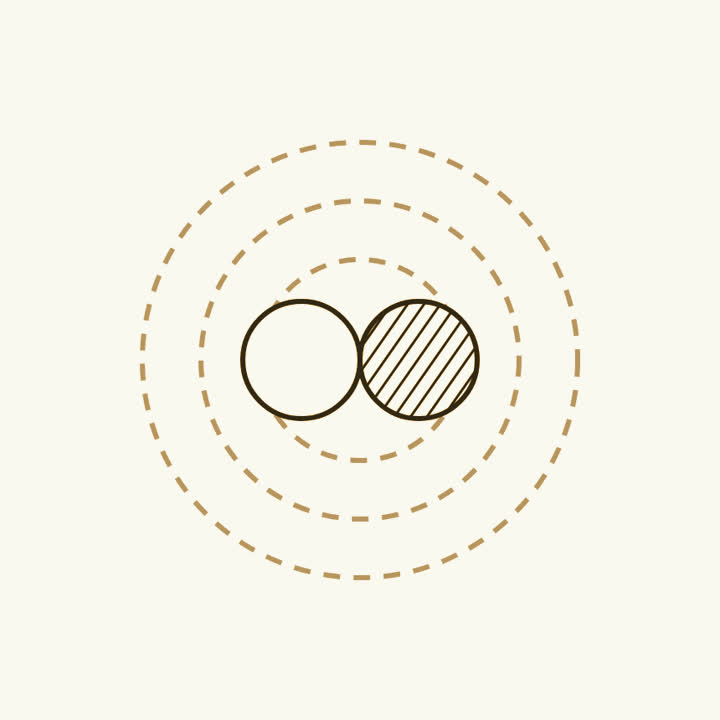
Every kind of particle of matter has an antimatter twin, with the opposite electric charge.
When a particle meets its antiparticle, the two destroy each other in a burst of energy. Physicists expect the Big Bang to have made matter and antimatter in equal amounts. Yet the universe we see is made almost entirely of matter.
If the amounts had stayed exactly equal, almost nothing would be left.
Nearly all the matter and antimatter would have met and turned into light. No stars, no planets and no people could have formed. So something, very early on, must have tipped the balance slightly toward matter.
In 1967, the physicist Andrei Sakharov worked out what any explanation would need.
Among his conditions, matter and antimatter must not behave as exact mirror images of each other. The early universe must also have been changing too fast to settle into balance. And some process must be able to change the total amount of matter.
Physicists have found matter and antimatter behaving slightly differently.
The first case was seen in 1964, in the decays of particles called kaons. In 2025, the LHCb experiment at CERN saw a difference for the first time in the family of particles that includes the proton. Every difference measured so far fits the Standard Model, the current theory of particles.
But the differences found so far are far too small.
The Standard Model allows only a small part of the imbalance needed to explain the universe. So most physicists think new physics must be involved. One popular idea links the imbalance to heavy partners of neutrinos in the very early universe.
Some simpler escapes have been tested and closed.
One idea was that antimatter might be pushed away by gravity instead of pulled. In 2023, the ALPHA experiment at CERN let atoms of antihydrogen fall, and they fell down, as ordinary matter does. And astronomers see no signs of large regions of antimatter meeting matter out in space.
So when a headline says the matter mystery is solved, ask if the effect is big enough.
That the imbalance exists is certain. We are made of it. What caused it is still unknown. Experiments on neutrinos planned for the coming years may offer new clues.
Sources
- Observation of the different behaviour of baryonic matter and antimatter, LHCb experiment, CERN. The 2025 result, in the experiment’s own words.
- Observation of the effect of gravity on the motion of antimatter, Nature, 2023. The ALPHA experiment showing antihydrogen falls down.
- CP violation, Wikipedia. From kaons in 1964 to the present, and why it is not enough.
Nearby ideas
- The mirror image of the electron. How an equation predicted antimatter, and a cloud chamber photograph found it.
- Mass and energy are the same thing. Why mass and energy are the same thing, and why a gram holds so much.
- Why do we have experiences at all?. Why brain science can track experience, but not yet explain why it exists.
- Are we alone in the universe?. Why no sign of life beyond Earth has been confirmed, despite planets everywhere.
- Why do we sleep?. Why every animal seems to need sleep, and the rival ideas about what it is for.
- How did life begin?. What is known about how life began, and which parts are still guesses.
- What is dark matter?. What the evidence says about dark matter, and why nobody knows what it is.
- What is speeding up the universe?. Why the universe's expansion is speeding up, and the rival ideas about why.