Cobra Effect · Relativity
Mass and energy are the same thing
Why mass and energy are the same thing, and why a gram holds so much.
7 cards, read aloud in 3:05, with a test and sources.
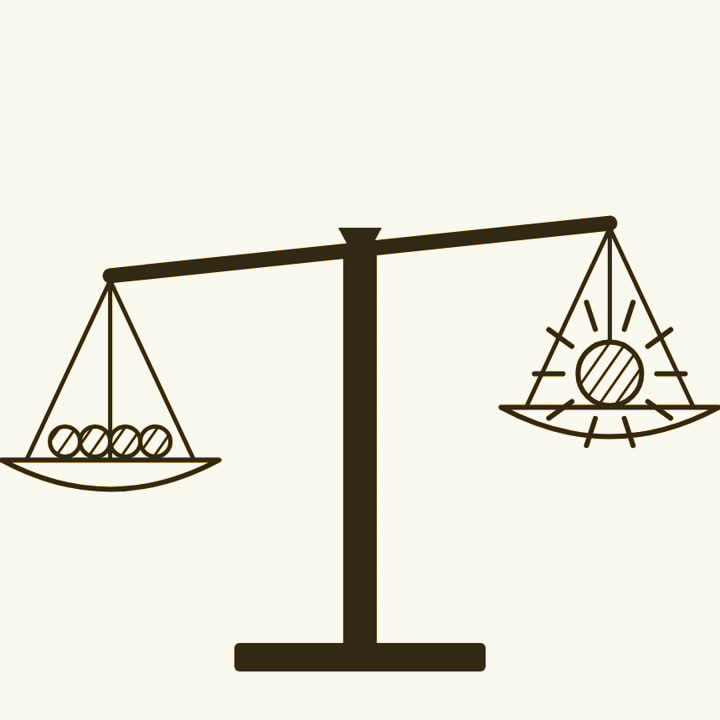
Weigh four hydrogen nuclei, then weigh the helium they fuse into.
The helium comes out lighter. Not by much. It is about seven parts in a thousand lighter than the four nuclei it was made from. The missing mass has not vanished. It has left as energy, and in the Sun that energy is sunlight.
In 1905 Albert Einstein wrote a paper just three pages long saying so.
If a body gives off energy, he argued, its mass must go down. Energy and mass are the same thing, measured in different units. The exchange rate between them is the speed of light, multiplied by itself. E equals m c squared.
That exchange rate is enormous.
The speed of light is about 300,000 kilometres a second, and it is multiplied by itself. So one gram of mass holds as much energy as burning about 3,000 tonnes of coal. The bomb that destroyed Hiroshima turned less than one gram of its mass into energy. It is why a nuclear power station needs so little fuel.
The Sun loses about four million tonnes of mass every second.
In its core, hydrogen fuses into helium, and every helium nucleus comes out a little light. The difference leaves as light and heat. The Sun has been doing this for four and a half billion years. Even so, it has used up only a tiny fraction of its mass.
Heat a cup of tea, and it gets heavier.
The energy you add has mass, so hot tea weighs a little more than the same tea cold. The difference is far too small for any scale to detect. A wound up spring weighs more than a loose one, for the same reason. Energy, wherever it is, counts as mass.
In 2005 physicists checked the formula to better than one part in a million.
A team from MIT and the US National Institute of Standards and Technology weighed atoms before and after they absorbed a neutron. They caught the energy given off as a flash of gamma rays. The mass that went missing matched that energy to within about one part in two million. Einstein’s three page argument had held for a century.
So when something seems to come from nothing, ask what got lighter.
Every flame, every battery and every star gives off energy by losing a little mass. For chemical reactions, the loss is too small to weigh. For nuclear ones, it is not. Hospitals rely on the complete version. A PET scanner catches the light made when electrons meet their antimatter partners and vanish. Nothing comes from nothing. It comes from mass.
Sources
- Relativity: The Special and the General Theory, Albert Einstein, 1916. Einstein’s own short book for general readers. The chapter on general results explains why energy and mass are the same thing.
- Mass–energy equivalence, Wikipedia. Einstein’s paper of 1905, what the formula means, and the tests of it. For the 2005 test, search Rainville, Nature, 2005.
- Proton–proton chain, Wikipedia. How the Sun fuses hydrogen into helium, how much lighter the helium comes out, and where the missing mass goes.
Nearby ideas
- Moving clocks run slow. Why moving clocks run slow, and how muons and airliners proved it.
- The constant speed of light. Why light is measured at the same speed by everyone, however they move.
- Falling feels like floating. Why falling feels like floating, and how that led Einstein to gravity.
- Gravity bends light. Why starlight bends around the Sun, and how a 1919 eclipse proved it.
- Gravity slows time. Why clocks run slower in stronger gravity, and why GPS has to allow for it.
- Space itself can ripple. Why colliding black holes shake space, and how LIGO finally felt it.
- Where not even light escapes. Why some stars collapse into places light cannot leave, and how we found them.