Cobra Effect · Big open questions
Why do we sleep?
Why every animal seems to need sleep, and the rival ideas about what it is for.
7 cards, read aloud in 2:38, with a test and sources.
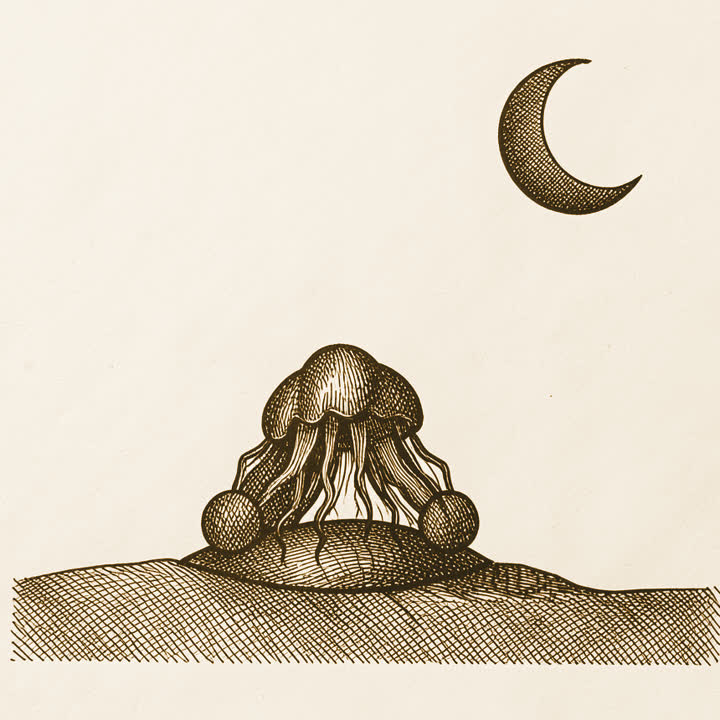
Every animal studied closely so far seems to need some form of sleep.
Flies sleep, worms sleep, and so does a kind of jellyfish that has no brain at all. Dolphins and some birds can sleep with one half of the brain at a time. A sleeping animal cannot watch for danger, so sleep must be worth that risk.
Losing sleep does real harm.
In experiments in Chicago in the 1980s, rats kept from sleeping for weeks sickened and died. In people, losing sleep quickly harms attention, mood and judgement. So sleep is doing something important. The puzzle is what.
One idea is that sleep helps the brain keep what it has learned.
Many studies find that sleeping after learning reduces forgetting. In sleeping rats, brain cells replay patterns from the maze they ran that day. But a brainless jellyfish sleeps too, so memory is unlikely to be the whole answer.
Another idea is that sleep resets the connections between brain cells.
Giulio Tononi and Chiara Cirelli proposed that learning while awake strengthens connections all over the brain. Sleep, they suggest, turns the overall strength back down, making room for the next day’s learning. Some findings fit the idea, and others do not.
A third idea made headlines, that sleep washes waste out of the brain.
A 2013 study in mice found that fluid moved more easily through the brain during sleep, clearing waste faster. In 2024, another team using a different method in mice found that clearance was slower during sleep. The two sides still disagree about whose methods are right.
Sleep may be doing several jobs at once.
It may also save energy, though the savings seem modest. Most of the detailed experiments are in animals, and linking them to people takes more work. As of 2026, there is no agreed answer to why sleep evolved.
So when a headline says scientists have found why we sleep, ask what the other studies say.
That sleep matters is settled. What it is for is still an open question, with several strong candidates. A good answer will have to explain the jellyfish as well as us.
Sources
- Scientists find sleep may not clear brain toxins as previously thought, UK Dementia Research Institute. The 2024 mouse study that challenged the brain washing idea.
- New method reignites controversy over brain clearance during sleep, The Transmitter. Both sides of the dispute, in their own words.
- Sleep in animals, Wikipedia. Sleep across the animal kingdom, from jellyfish to dolphins.
Nearby ideas
- Sleep and consolidation. Sleep is when the day’s learning gets filed away.
- The man who could not make new memories. How one man's lost memory showed that remembering and learning skills are separate.
- How did life begin?. What is known about how life began, and which parts are still guesses.
- What is dark matter?. What the evidence says about dark matter, and why nobody knows what it is.
- What is speeding up the universe?. Why the universe's expansion is speeding up, and the rival ideas about why.
- Why is there more matter than antimatter?. Why the universe is made of matter, when the Big Bang should have made equal antimatter.
- Why do we have experiences at all?. Why brain science can track experience, but not yet explain why it exists.
- Are we alone in the universe?. Why no sign of life beyond Earth has been confirmed, despite planets everywhere.