Cobra Effect · Big open questions
Why do we have experiences at all?
Why brain science can track experience, but not yet explain why it exists.
7 cards, read aloud in 2:58, with a test and sources.
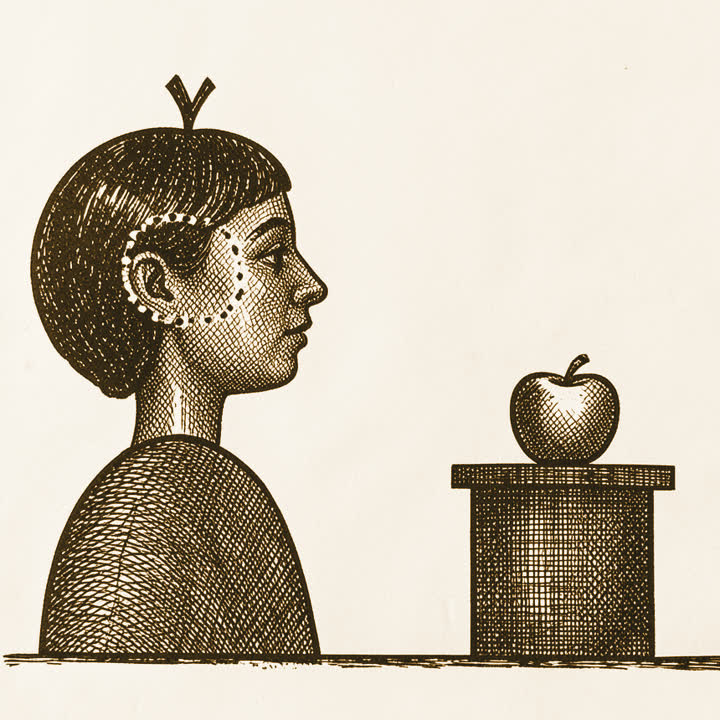
Scientists can explain a great deal about how the brain handles what we see.
They can trace how signals from the eye are sorted into edges, colours and faces. But there is a further question. Why does any of that processing feel like something from the inside? The redness of a red apple is not obviously explained by signals alone.
In 1995, the philosopher David Chalmers called this the hard problem of consciousness.
He set it apart from the easy problems, such as explaining attention, memory and how we report what we see. The easy problems are still very difficult, but it is clear what an answer to them would look like. For experience itself, it is not clear what an answer would even look like. The wider puzzle of how mind relates to body is centuries older.
Neuroscientists hunt for the brain activity that goes along with conscious experience.
In 1990, Francis Crick and Christof Koch urged researchers to search for these neural correlates of consciousness. Experiments compare the brain when a person notices something with the brain when the same thing goes unnoticed. Finding what goes along with experience is not the same as explaining it.
Two leading theories give very different answers.
Global workspace theory says something becomes conscious when it is broadcast widely across the brain. Integrated information theory says consciousness depends on how much a system’s parts work together as one whole. It even suggests that very simple systems could have a tiny amount of experience.
In 2025, rival researchers published a joint experiment designed to challenge both theories.
Supporters of each theory agreed in advance which results would count against their own. The study recorded brain activity in two hundred and fifty six people, using several different methods. The results matched some predictions of each theory, and seriously challenged key claims of both.
In 1998, Christof Koch bet David Chalmers a case of wine.
Koch bet that within twenty five years, a clear brain signature of consciousness would be found. In 2023, he conceded, and paid up. They made a new bet, running to 2048.
So when someone claims to have explained consciousness, ask which problem they have solved.
Finding the brain activity that goes with experience is real progress. Explaining why experience exists at all is a different matter. As of 2026, there is no agreed theory, and some philosophers argue that the hard problem itself is a mistake.
Sources
- Consciousness, Stanford Encyclopedia of Philosophy. The hard problem and the major theories.
- Landmark experiment sheds new light on the origins of consciousness, Allen Institute. The 2025 joint test of the two leading theories.
- A 25-year-old bet about consciousness has finally been settled, Scientific American. How Koch lost the wine bet, and made a new one.
Nearby ideas
- The patients with a divided brain. What patients with a divided brain revealed, and the myth it was stretched into.
- The man who could not make new memories. How one man's lost memory showed that remembering and learning skills are separate.
- Are we alone in the universe?. Why no sign of life beyond Earth has been confirmed, despite planets everywhere.
- Why do we sleep?. Why every animal seems to need sleep, and the rival ideas about what it is for.
- How did life begin?. What is known about how life began, and which parts are still guesses.
- What is dark matter?. What the evidence says about dark matter, and why nobody knows what it is.
- What is speeding up the universe?. Why the universe's expansion is speeding up, and the rival ideas about why.
- Why is there more matter than antimatter?. Why the universe is made of matter, when the Big Bang should have made equal antimatter.