Cobra Effect · Light and electricity
Light takes time to arrive
How a moon of Jupiter and a spinning wheel showed that light takes time to arrive.
7 cards, read aloud in 4:04, with a test and sources.
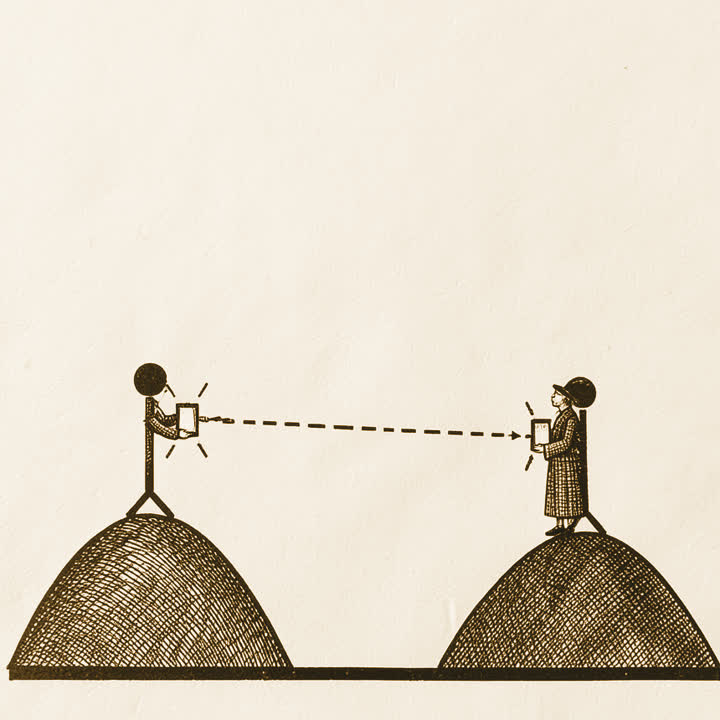
For a long time, most thinkers assumed light arrived the instant it set out.
A flash of cannon fire seems to reach your eyes at once, however far away the gun is. Descartes held that light crossed any distance in no time at all. Galileo was not so sure. In 1638 he described uncovering lanterns on hills a distance apart, and watching for a delay. He tried it over less than a mile, and could not tell. Light, he wrote, was if not instantaneous then extraordinarily rapid.
In 1676 Ole Roemer found a clock in the sky, in the moons of Jupiter.
Jupiter’s moon Io slips into Jupiter’s shadow about every forty two and a half hours, as regular as a clock. Astronomers at the Paris Observatory noticed that its eclipses ran early when the Earth was near Jupiter, and late when it was far away. Roemer, a young Danish astronomer working there, argued that the light from Io simply took longer to reach us from farther away. He estimated that light took about twenty two minutes to cross the width of the Earth’s orbit.
He staked his idea on a prediction about one eclipse.
In September 1676 he told the Paris Academy that Io would come out of Jupiter’s shadow that November about ten minutes later than the tables said. Giovanni Cassini, the leading astronomer at the observatory, had considered the same explanation and rejected it. Christiaan Huygens and Isaac Newton came to accept Roemer’s idea. Many others did not. It was not fully settled until James Bradley measured a small shift in the positions of stars, in the late 1720s.
Huygens turned Roemer’s delay into a speed.
Roemer gave a time, not a speed. Turning one into the other needed the size of the Earth’s orbit, which was only roughly known. In his book on light, published in 1690, Huygens worked out a speed of more than two hundred thousand kilometres a second, in today’s units. That is short of the true figure by more than a quarter, but it was the right size. Light was astonishingly fast, but it was not infinitely fast.
In 1849 Hippolyte Fizeau timed light across Paris with a spinning wheel.
He sent a beam from his father’s house in Suresnes through the gaps of a wheel with seven hundred and twenty teeth, to a mirror on Montmartre about eight and a half kilometres away. Spun slowly, the wheel let the returning light back through the same gap. Spun fast enough, the next tooth moved into the way while the light was still on its journey, and the light was blocked. From the speed of the wheel, he worked out a speed of light only about four and a half per cent too high.
A year later, Leon Foucault showed that light slows down in water.
He used a fast spinning mirror in place of a wheel, so the light needed only a short path. Light sent through a tube of water arrived later than light sent through air. That mattered. If light were a stream of tiny particles, the theory of the day said it should go faster in water. If it were a wave, slower. In 1862 Foucault measured its speed in air to within one per cent of today’s value.
So when you look at something, ask how long ago its light set out.
Sunlight is about eight minutes and twenty seconds old when it reaches you. Moonlight is just over a second old. Light from the nearest star beyond the Sun set out more than four years ago. Roemer found the delay by taking a small mismatch in the eclipse times seriously. Everything you see, you see as it was.
Sources
- Roemer’s determination of the speed of light, Wikipedia. The eclipses of Io, the prediction of 1676, what Roemer measured and what Huygens made of it.
- Fizeau’s measurement of the speed of light in air, Wikipedia. The lamp in Suresnes, the mirror on Montmartre and the toothed wheel in between.
- Foucault’s measurements of the speed of light, Wikipedia. The spinning mirror, light in water against light in air, and the result of 1862.
Nearby ideas
- The constant speed of light. Why light is measured at the same speed by everyone, however they move.
- There is light on both sides of the rainbow. How thermometers, silver salts and a glowing screen found light we cannot see.
- Lightning is a giant spark. How a thread, a jar and an iron rod showed that lightning is electricity.
- A frog’s twitch led to the first battery. How an argument over twitching frogs’ legs gave the world its first battery.
- A moving magnet makes electricity. How a swinging compass needle led, in eleven years, to the first generator.
- Light is a wave of electricity and magnetism. How equations predicted invisible waves, and sparks across a room proved them real.
- Why the sky is blue. How a hazy glass tube and a calculation explained the colour of the sky.
- White light is every colour at once. How a second prism showed the colours were in sunlight all along.