Cobra Effect · Light and electricity
Light is a wave of electricity and magnetism
How equations predicted invisible waves, and sparks across a room proved them real.
7 cards, read aloud in 3:48, with a test and sources.
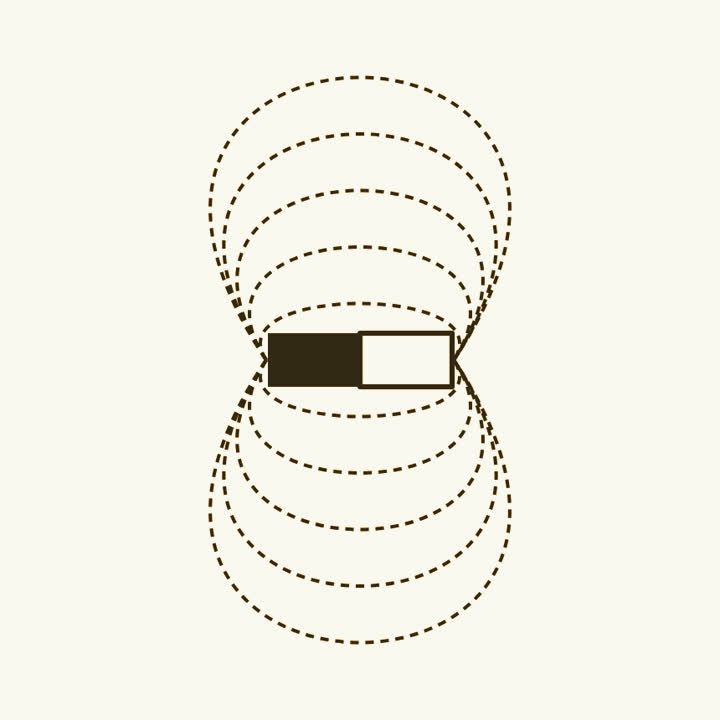
Faraday pictured magnets and currents surrounded by invisible lines of force.
Sprinkle iron filings around a magnet, and they settle into curving lines from one end to the other. Faraday, who had little mathematics, thought of those lines as something real, filling the space around the magnet. James Clerk Maxwell, a young Scottish physicist, took the idea seriously and began to put it into equations. Over the next ten years he built a mathematical theory of electricity and magnetism.
Maxwell’s equations said that electricity and magnetism could travel as a wave.
A changing magnetism makes electricity, as Faraday found. Maxwell’s theory said a changing electricity makes magnetism too. Each change could set off the next, so the pair could ripple outwards through empty space, carrying itself along. The theory also gave the speed of that ripple, worked out from laboratory measurements of electricity and magnetism. Maxwell used figures from two German physicists, Wilhelm Weber and Rudolf Kohlrausch.
In 1865 the speed came out almost exactly the speed of light.
The numbers going into the calculation came from measuring electricity and magnetism, not light. Yet the answer matched the speed of light that Fizeau and Foucault had measured. Maxwell concluded that light itself is a wave of electricity and magnetism. He counted radiant heat among such waves too, and left room for other kinds.
Maxwell died in 1879 without seeing his waves made or caught.
His theory was admired, but it was not yet on firm ground. No one had shown the waves were real. Making one would need electricity that changed direction extremely quickly. Catching one would need a detector sensitive enough to notice it. The man who did both was a young German professor, Heinrich Hertz.
In 1887 Heinrich Hertz made a spark, and a tiny spark answered it across the room.
At Karlsruhe he built a transmitter: two metal spheres on rods, with a small gap between the rods where sparks jumped. Across the darkened room stood a loop of wire with a gap of its own. When the transmitter sparked, a faint spark appeared in the gap of the loop, with no wire joining them. Something invisible had crossed the room.
Hertz showed that his invisible waves behaved just like light.
He bounced the waves off a metal sheet, and found still spots between strong ones. From their spacing he measured the length of the waves. The waves could be reflected and bent, just as light can. And they travelled at the speed of light. Maxwell had been right. These were waves of the same kind as light, only far too long for eyes to see.
So when an idea predicts something no one has seen, ask how you could go and look.
Maxwell’s waves began as mathematics. Hertz turned them into sparks you could watch. In 1901 Guglielmo Marconi reported hearing a radio signal, the letter S in Morse code, sent across the Atlantic from Cornwall to Newfoundland. Radio, television, radar, mobile phones and wifi all use Maxwell’s waves. The unit of how often a wave repeats, the hertz, is named after the man who first caught them.
Sources
- A commentary on Maxwell’s dynamical theory of the electromagnetic field, Philosophical Transactions A, 2015. Why Maxwell’s 1865 paper mattered, and how it tied light to electricity and magnetism.
- First generation and experimental proof of electromagnetic waves, Engineering and Technology History Wiki. Hertz’s spark transmitter, his wire loop receiver, and what he measured with them.
- Reception of transatlantic radio signals, 1901, Engineering and Technology History Wiki. Marconi, the kite aerial on Signal Hill, and the letter S sent from Cornwall.
Nearby ideas
- A moving magnet makes electricity. How a swinging compass needle led, in eleven years, to the first generator.
- Light takes time to arrive. How a moon of Jupiter and a spinning wheel showed that light takes time to arrive.
- Why the sky is blue. How a hazy glass tube and a calculation explained the colour of the sky.
- White light is every colour at once. How a second prism showed the colours were in sunlight all along.
- There is light on both sides of the rainbow. How thermometers, silver salts and a glowing screen found light we cannot see.
- Lightning is a giant spark. How a thread, a jar and an iron rod showed that lightning is electricity.
- A frog’s twitch led to the first battery. How an argument over twitching frogs’ legs gave the world its first battery.