Cobra Effect · Big open questions
Is gravity quantum?
What Feynman asked in 1957, the rival answers, and the test that could decide.
7 cards, read aloud in 5:04, with a test and sources.
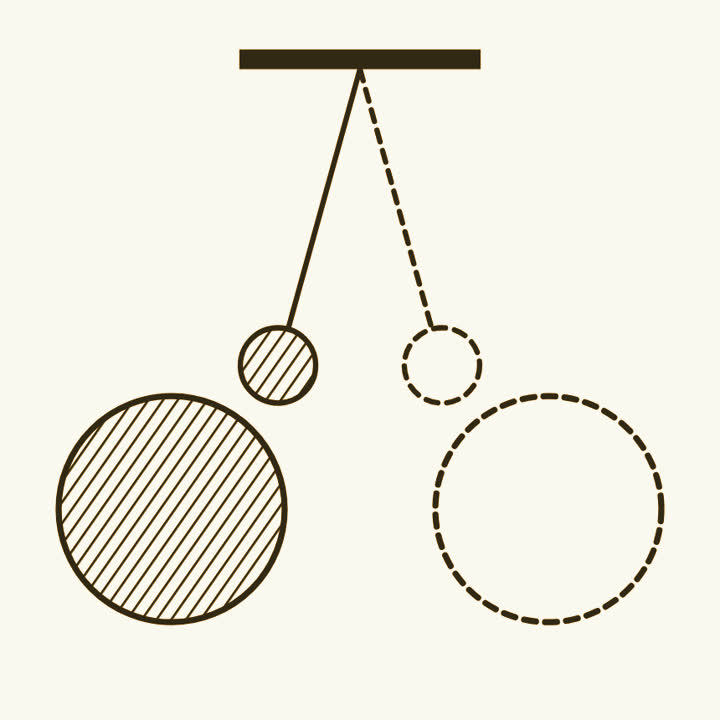
January 1957, North Carolina. Richard Feynman describes a ball in two places at once.
Quantum rules let a particle be in two states at once. Feynman imagined linking one to a ball a centimetre across, so that the ball ends up in two positions too. A ball has gravity. So does its pull point two ways at once? If quantum mechanics holds at every scale, he argued, then gravity has to follow quantum rules as well. He left himself a way out. Perhaps quantum mechanics fails when things get too heavy. We had better make gravity quantum, he is recorded as saying, or else find a new principle.
Both theories pass every test. They just cannot both be the whole story.
Einstein’s theory of gravity treats space and time as smooth and definite. Gravity has been checked from a fraction of a millimetre up to the scale of the visible universe. Quantum theory describes everything else, and it says things can be in several states at once. No experiment has ever caught the two disagreeing. The clash is on paper, in places experiments cannot reach. Testing it head on would take energies about a million billion times beyond the biggest collider.
The leading ideas all make gravity quantum, in different ways.
String theory, since 1974, says particles are tiny vibrating strings, and that one kind of vibration carries gravity. Loop quantum gravity, developed by Carlo Rovelli and Lee Smolin in the mid 1990s, says areas and volumes of space come in steps. A third approach, from 1987, builds space and time out of scattered events, linked only by what comes before what. Before cosmic expansion was found to be speeding up, one of its authors, Rafael Sorkin, used it to guess the rough size of such an effect. A hint, not a proof. None of the three has yet passed a clear experimental test.
Or perhaps gravity is not quantum at all.
Lajos Diosi and Roger Penrose proposed that gravity is what stops big things being in two places. A heavy enough object, they suggest, settles into one place by itself. The simplest version predicted a faint glow of radiation from ordinary matter. A detector under the Gran Sasso mountain in Italy looked for it and found none. That ruled out the simplest version only. Diosi himself was one of the authors. In 2023 Jonathan Oppenheim of University College London published a theory in which space and time stay classical, but must jitter at random. That jitter is something experiments can look for.
Searches for graininess in space have found nothing so far.
In 2009 NASA’s Fermi telescope timed gamma rays that had travelled for about seven billion years. High and low energy light arrived together, which ruled out one simple kind of grainy space. At Fermilab, near Chicago, the Holometer used two laser instruments with arms about 40 metres long to look for a shared jitter that one theory predicted. In 2015 it reported none. Each result closed one door. Neither showed that space is smooth.
One experiment could show gravity behaving in a quantum way.
In 2017 two groups, one led by Sougato Bose and the other by Chiara Marletto and Vlatko Vedral, proposed the same test. Take two tiny diamonds, each about a hundred billionth of a gram, and put each in two places at once. Hold them a fraction of a millimetre apart, shielded from everything but each other’s gravity. If the two become entangled, sharing a single quantum state, then gravity carried quantum information between them. Many physicists would take that as the first sign of gravity behaving in a quantum way. Some dispute how much it would prove.
So when you hear that gravity has been united with quantum theory, ask what was measured.
As of 2026, nobody has run that test. The heaviest things yet put in two places at once are clumps of a few thousand sodium atoms. The diamonds would be tens of millions of times heavier. In 2026 Bose estimated that it would take more than ten years. If the diamonds do entangle, then the shape of space itself can be in two states at once. Why we only ever see one smooth space would then be a question of the same kind as why we never see a table in two places.
Sources
- Quantum Gravity Tests Coming Soon, Philip Ball, APS Physics magazine, 2026. The experiments now being designed to show whether gravity is quantum, and the arguments over what they would prove.
- The Necessity of Gravitational Quantization, The Role of Gravitation in Physics: Report from the 1957 Chapel Hill Conference. The transcript of the session in which Feynman set out his thought experiment, and the way out he allowed himself.
- Physicists Find a Way to See the ‘Grin’ of Quantum Gravity, Natalie Wolchover, Quanta Magazine, 2018. A plain account of the two diamond test and why it might be within reach.
- Quantum Gravity, Steven Weinstein and Dean Rickles, Stanford Encyclopedia of Philosophy. The problem, the main approaches, and why evidence is so scarce.
Nearby ideas
- Gravity reaches a quantum wave. A tilted crystal, a beam of neutrons, and gravity shifting a quantum wave.
- Why does a measurement give one result?. Two rules that clash, four rival answers, and the experiments that could decide.
- Is the Planck length the smallest possible length?. Where the smallest length came from, and what has actually been measured.
- Why do we sleep?. Why every animal seems to need sleep, and the rival ideas about what it is for.
- How did life begin?. What is known about how life began, and which parts are still guesses.
- What is dark matter?. What the evidence says about dark matter, and why nobody knows what it is.
- What is speeding up the universe?. Why the universe's expansion is speeding up, and the rival ideas about why.
- Why is there more matter than antimatter?. Why the universe is made of matter, when the Big Bang should have made equal antimatter.