Cobra Effect · Big open questions
Why does a measurement give one result?
Two rules that clash, four rival answers, and the experiments that could decide.
7 cards, read aloud in 4:46, with a test and sources.
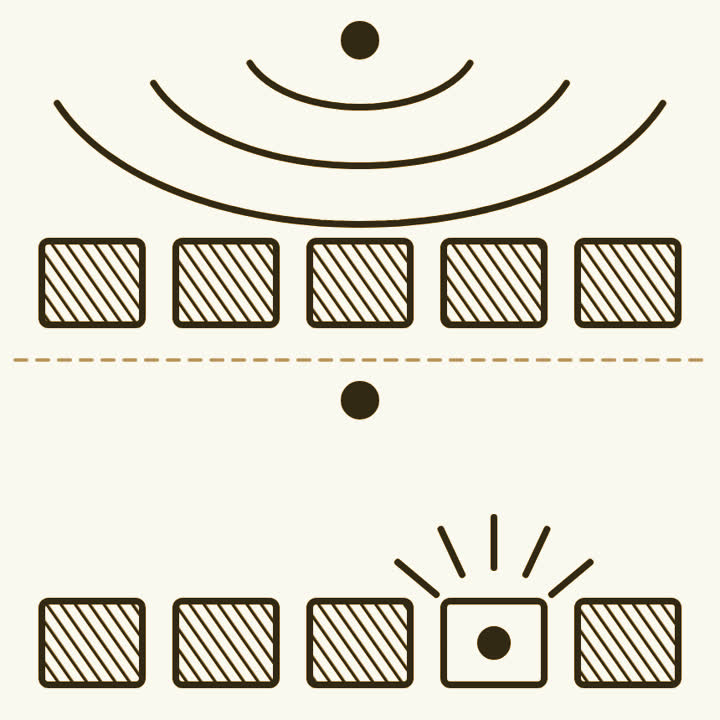
Quantum mechanics runs on two rules, and they do not fit together.
The first is an equation Erwin Schrodinger published in 1926. It describes a particle as a wave that spreads smoothly along every path open to it. The second covers measurements. A detector never finds a spread out wave. It finds one particle, in one place. Which place is a matter of chance, and in 1926 Max Born found the rule that gives the odds. In 1932 John von Neumann set the two rules side by side. One is smooth and certain. The other is sudden and random.
Nobody disputes the predictions. The argument is about what happens.
Used together, the two rules have passed every test for a century. But a detector is made of atoms too. Apply the first rule to it, and the detector should end up in several states at once. Large things do leak traces of themselves into their surroundings, and that hides their wave behaviour almost at once. By wide agreement, that explains why we never see blurred results. It does not explain why we see one result at all. This is called the measurement problem.
One answer is to stop asking.
The view that grew out of the work of Niels Bohr and Werner Heisenberg in the 1920s says the theory gives the odds of each result, and no more. It was later named the Copenhagen interpretation, and it is close to what most textbooks teach. Its trouble is the dividing line. Where does the quantum thing end and the measuring device begin? Nobody has drawn that line in a way everyone accepts.
A second answer keeps only the smooth rule, and accepts every outcome.
In 1957 a Princeton student, Hugh Everett, proposed that the wave never collapses at all. When a detector meets a particle in two states, the detector ends up in two states too, and so does anyone reading it. Each version sees one result. Bryce DeWitt later gave the idea its famous name, many worlds. It needs no extra rule. Its trouble is chance. If every outcome happens, what does a seventy percent chance mean?
A third answer adds something to the wave.
Louis de Broglie proposed it in 1927 and then gave it up. David Bohm rediscovered it in 1952. Every particle has a definite position at all times, and the wave guides where it goes. One result occurs because the particle was always somewhere. The cost is that a particle’s motion can depend instantly on others far away, which sits badly with relativity. Experiments since have ruled out the gentler option, in which each particle carries hidden instructions and nothing reaches across the gap.
A fourth answer says the collapse is real, and that makes it testable.
In 1986 the physicists Ghirardi, Rimini and Weber proposed that every particle collapses by itself, at random, very rarely. For one particle, about once in a hundred million years. For a detector made of countless particles, almost at once. Lajos Diosi and Roger Penrose suggested that gravity is the trigger. Unlike the other answers, this one predicts tiny departures from standard quantum theory, such as a faint glow of radiation from ordinary matter. A detector deep under the Gran Sasso mountain in Italy looked for that glow and found none. That ruled out the simplest gravity version, and no more.
So when you hear what quantum mechanics really means, ask which answer is being used.
The equations and their predictions are settled. What they describe is not. In a 2025 survey by the journal Nature, about a third of the physicists who replied chose Copenhagen, and no answer won a majority. Experiments may yet decide. Each year, bigger things are shown to behave as waves. By early 2026 that included clumps of several thousand sodium atoms. If that ever fails at some size, collapse is real. If it never does, the choice between the others stays open. As of 2026, nobody knows why a measurement gives one result.
Sources
- Philosophical Issues in Quantum Theory, Wayne Myrvold, Stanford Encyclopedia of Philosophy. The measurement problem set out carefully, and the three families of answer: add to the wave, change its equation, or keep the equation alone.
- Collapse Theories, Stanford Encyclopedia of Philosophy. The 1986 proposal and its descendants, and how experiments are closing in on them.
- Physicists Divided on What Quantum Mechanics Says about Reality, Elizabeth Gibney, Nature, reprinted by Scientific American. The 2025 survey of more than 1,100 physicists, in which no interpretation won a majority.
- Underground test of gravity-related wave function collapse, Donadi and colleagues, Nature Physics. The Gran Sasso search for the faint radiation that gravity driven collapse would cause. The abstract says exactly which version it rules out.
Nearby ideas
- Schrodinger’s cat. A thought experiment built to show where the quantum rules run out.
- Decoherence. Why big things never show two states at once.
- Is gravity quantum?. What Feynman asked in 1957, the rival answers, and the test that could decide.
- Why do we sleep?. Why every animal seems to need sleep, and the rival ideas about what it is for.
- How did life begin?. What is known about how life began, and which parts are still guesses.
- What is dark matter?. What the evidence says about dark matter, and why nobody knows what it is.
- What is speeding up the universe?. Why the universe's expansion is speeding up, and the rival ideas about why.
- Why is there more matter than antimatter?. Why the universe is made of matter, when the Big Bang should have made equal antimatter.