Cobra Effect · Science and philosophy
The trolley problem
Why harm that follows from a plan feels different from harm that is the plan.
7 cards, read aloud in 3:20, with a test and sources.
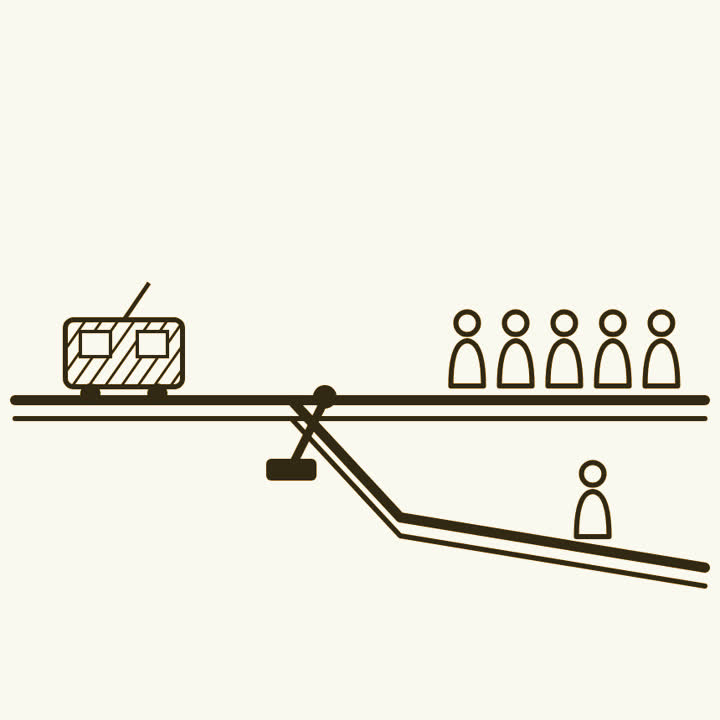
A runaway tram. Five workers on the track ahead. You are at the switch.
Pull the lever and the tram turns onto a side track, where one worker is standing. Do nothing and five die. Pull and one dies. Most people pull. Around nine in ten, in survey after survey.
Same tram. Same five workers. Now you are on a footbridge above the track.
Beside you is a very large man. If you push him off, his body will stop the tram. He will die and the five will live. The arithmetic is identical. One for five. Most people will not push. Around nine in ten refuse.
Philippa Foot built the tram in 1967.
She was an Oxford philosopher writing about abortion and the old doctrine of double effect. Her version had a driver who could steer toward one or toward five. In 1976 Judith Jarvis Thomson moved the driver to a bystander at a switch, added the footbridge, and gave the puzzle its name. It has been arguing with itself ever since.
What is the difference?
At the switch, the one worker dies as a side effect of turning the tram. If he stepped away, the plan would still work. On the bridge, the man’s body is the plan. If he stepped away, five would die. You are using him. That line, between harm you cause and harm you use, is one the mind seems to draw without being taught. Thomson also asked about a surgeon who could take one healthy visitor apart to save five patients. Almost nobody says yes.
The brain agrees. It just doesn’t agree with itself.
In 2001 Joshua Greene scanned people while they answered. The switch case lit up the regions used for calculation. The footbridge lit up the regions used for feeling. Pushing a man with your hands is a different act to the mind than pulling a lever, even when the sum is the same. Whether the feeling is wisdom or a bug is the whole argument.
It stopped being a game when cars started driving themselves.
A car that must choose between two collisions is the tram with a computer at the switch. In 2018 a team at MIT reported 40 million answers from people in 233 countries and territories about who a car should spare. The answers differed by country. Somebody has to write the rule. The philosophers had a fifty year head start.
Use it on your own decisions, not on trams.
When a plan is justified by numbers, ask which case you are in. Is the harm a side effect you would avoid if you could? Or is somebody’s loss the mechanism that makes the plan work? The second kind is the footbridge, and you should feel the push in your hands before you decide. Five for one is easy on paper. Foot and Thomson showed it never was on the bridge.
Sources
- Trolley problem, Wikipedia. Foot’s 1967 version, Thomson’s switch and footbridge, the survey numbers, the brain scans, and the self driving car debate.
- Would You Kill the Fat Man?, David Edmonds, 2014. A short, funny history of the problem and the philosophers who built it, with Foot and Thomson at the centre. The best single book on it.
- Doctrine of Double Effect, Stanford Encyclopedia of Philosophy. The old rule Foot was testing. Why a harm you foresee is treated differently from a harm you intend, and the arguments against drawing the line there.
Nearby ideas
- The framing effect. The same facts, worded differently, lead to different choices.
- The ship of Theseus. Replace every part, and ask whether it is still the same thing.
- Inversion. To find the path to success, first ask what would guarantee failure.
- The placebo effect. Much of what a dummy pill seems to do would have happened anyway.
- The replication crisis. Why many famous findings vanished when others tried them again.
- Cargo cult science. Science can copy every outward form and still miss the honesty.
- Fermi estimation. Break an impossible question into small guesses you can make.
- Absence of evidence. Finding nothing only counts if you would have found it.