Cobra Effect · Science and philosophy
The ship of Theseus
Replace every part, and ask whether it is still the same thing.
6 cards, read aloud in 2:26, with a test and sources.
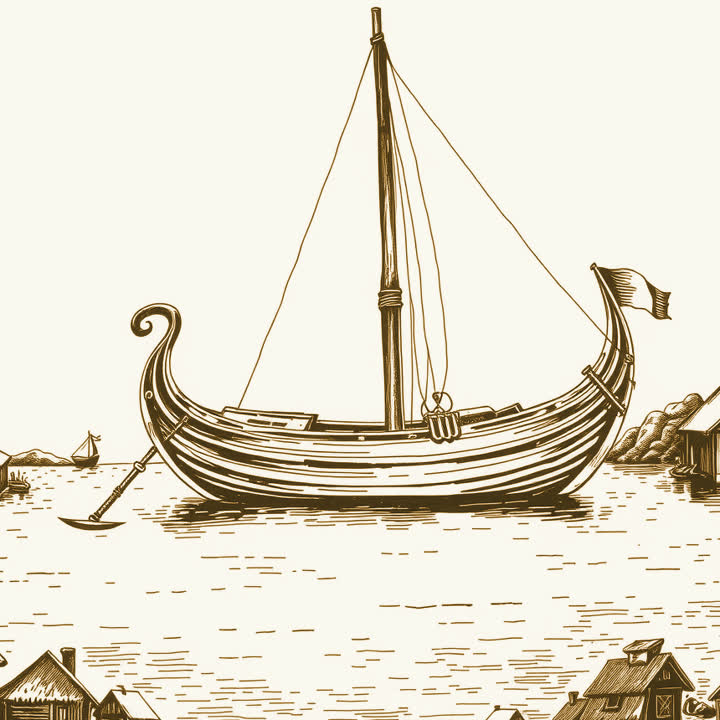
Athens keeps a hero’s ship in the harbour. Every year, a plank rots.
The ship that carried Theseus home from Crete, so the Athenians say. They preserve it for centuries, and each time a timber goes soft they replace it. Plutarch wrote it down around the year 100. By then the philosophers had a question.
Is it still the same ship?
Not one original plank remains. Some said yes. It has the same shape, the same name, the same berth, and it never stopped being the ship. Some said no. A thing is its parts, and every part is new. Plutarch said it had become the standard example for any argument about things that grow.
Thomas Hobbes made it worse in 1655.
Suppose someone had kept every plank that was thrown away. And, in a shed, rebuilt the old ship from them, rot and all. Now there are two ships. Which one is the ship of Theseus? The one with the history, or the one with the wood?
You are the ship.
Most of the cells in your body are replaced over the years. The company you joined has none of the people who hired you. The band on tour has no original members. The town has the same name and none of the same buildings. Identity, it turns out, is not a fact about the parts.
The trick is that same has more than one meaning.
Same stuff. Same shape. Same story. Same job. The ship in the harbour is the same by story and job, and not by stuff. The one in the shed is the same by stuff, and by nothing else. The argument only rages because the word is doing four jobs at once.
So when someone asks, is it still the same, ask back.
Same in what sense, and why does it matter here? Same team, for the sake of a contract? Same product, for the sake of a customer? Same person, for the sake of a promise? Answer that, and the puzzle dissolves. The ship does not care. The people who need it do.
Sources
- Life of Theseus, Plutarch, around the year 100. The ship, the planks and the philosophers, in a few sentences of the Parallel Lives. Section 23.
- Reasons and Persons, Derek Parfit, 1984. Part three takes the puzzle to people. Teletransporters, split brains, and why identity may not be what matters.
- Ship of Theseus, Wikipedia. Plutarch, Hobbes’s second ship, Heraclitus’s river, and the modern versions from grandfather’s axe to Trigger’s broom.
Nearby ideas
- The map is not the territory. Every model leaves something out, and that is where it fails.
- The problem of induction. A long run of past successes cannot prove the next one.
- Falsifiability. A claim that nothing could disprove tells you nothing.
- The trolley problem. Why harm that follows from a plan feels different from harm that is the plan.
- The placebo effect. Much of what a dummy pill seems to do would have happened anyway.
- The replication crisis. Why many famous findings vanished when others tried them again.
- Cargo cult science. Science can copy every outward form and still miss the honesty.
- Fermi estimation. Break an impossible question into small guesses you can make.