Cobra Effect · Science and philosophy
The placebo effect
Much of what a dummy pill seems to do would have happened anyway.
6 cards, read aloud in 2:49, with a test and sources.
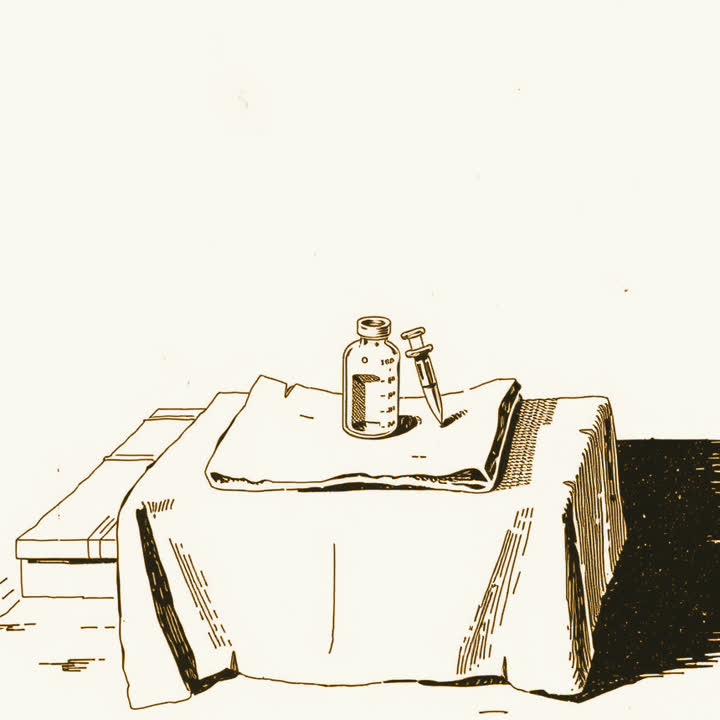
Italy, 1944. The morphine has run out.
So the story goes, a field hospital near Anzio is full of wounded men and the anaesthetist Henry Beecher has nothing left to give them. A nurse injects a soldier with salt water and tells him it is morphine. His pain eases. He goes through surgery. Beecher never published the scene himself, and it may be a legend that grew up around his name.
What he did publish was a number.
In 1955 Beecher wrote a paper called The Powerful Placebo. He pooled fifteen trials and reported that about a third of patients were helped by a dummy pill or injection. The paper made the placebo a force of its own. Every drug, from then on, would have to beat it.
That is the placebo effect. Or it is what people think it is.
A treatment with nothing in it makes the patient feel better. The expectation does the work. But look at Beecher’s third again. Many of those patients would have improved anyway. Illnesses have a natural course. People come in at their worst and drift back towards normal, dummy pill or not. In 1997 two researchers went back through his fifteen trials and found no proof of a placebo effect in any of them.
So a placebo group does not measure expectation. It measures everything else.
Natural recovery. The drift back from a bad day. The effect of being watched and cared for. Wanting to please the doctor. And expectation, somewhere in the mix. A trial gives the dummy to half the patients so that all of it can be subtracted. What is left is the drug.
Take everything else away and what remains is real, and mostly about pain.
In 2001 two Danish researchers compared placebo groups with patients given nothing at all. Across dozens of conditions, the dummy pill made little difference to anything a doctor could measure. It did help with pain, nausea and other things the patient reports. The placebo changes how you feel about the symptom, more than it changes the disease.
Ask what the control group did.
When a treatment works, ask compared to what. Compared to nothing, almost everything works, because people get better. Compared to a dummy, most things don’t. And when a remedy makes you feel better, you are allowed to feel better. Just don’t mistake the feeling for a cure.
Sources
- Placebo, Wikipedia. Beecher’s 1955 paper, the 1997 reassessment that found no placebo effect in his data, and the 2001 comparison with no-treatment groups. Search Kienle and Kiene for the reassessment.
- Bad Science, Ben Goldacre, 2008. A chapter on the placebo, what it does and does not do, sits inside a longer book about how to tell good evidence from bad. Funny, and angry in the right places.
- Henry K. Beecher, Wikipedia. The anaesthetist behind The Powerful Placebo, his wartime work, and his later and more lasting campaign for consent and controlled trials.
Nearby ideas
- Regression to the mean. Extreme results drift back towards normal, whatever you do.
- The Hawthorne effect. Being watched changes what people do, and muddies what you measure.
- The replication crisis. Why many famous findings vanished when others tried them again.
- Cargo cult science. Science can copy every outward form and still miss the honesty.
- Fermi estimation. Break an impossible question into small guesses you can make.
- Absence of evidence. Finding nothing only counts if you would have found it.
- Clarke’s third law. Advanced technology can look like magic, and so can a good trick.
- Schrodinger’s cat. A thought experiment built to show where the quantum rules run out.